




After years of struggling under austerity imposed by its European Union partners and a chilly shoulder from the United States, Greece has embraced the advances of China, its most ardent and geopolitically ambitious suitor.
While Europe was busy squeezing overextended Greece, the Chinese swooped in with bucket-loads of investments that have begun to pay off, economically and by apparently giving China a political foothold in Greece, and by extension, in Europe.
Last summer, Greece helped stop the European Union (EU) from issuing a unified statement against Chinese aggression in the South China Sea. This June, Greece prevented the bloc from condemning China’s human-rights record. Days later, it opposed tougher screening of Chinese investments in Europe.
Greece’s diplomatic stance did not go unnoticed by its European partners or by the United States, all of which had previously worried that the country’s economic vulnerability might make it a ripe target for Russia, always eager to divide the bloc.
Instead, it is the Chinese who have become an increasingly powerful foreign player in Greece after years of assiduous courtship and checkbook diplomacy.
Among those initiatives, China plans to make the Greek port of Piraeus the “dragon head” of its vast “One Belt, One Road” economic development project, a new Silk Road into Europe.
When Germany treated Greece as the eurozone’s financial delinquent, China designated a recovery-hungry Greece its “most reliable friend” in Europe.
“While the Europeans are acting toward Greece like medieval leeches, the Chinese keep bringing money,” said Costas Douzinas, head of the Greek Parliament’s foreign-affairs and defense committee, and a member of the governing Syriza party.
China has already used its economic muscle to stamp a major geopolitical footprint in Africa and South America as it scours the globe for natural resources to fuel its economy. If China was initially welcomed as a deep-pocketed investor — and an alternative to the United States — it has faced growing criticism that it is less an economic partner than a 21st-century incarnation of a colonialist power.
If not looking for natural resources in Europe, China has for years invested heavily across the bloc, its largest trading partner. Yet concerns are rising that China is using its economic clout for political leverage.
Quid pro quo?
Douzinas said China had never explicitly asked Greece for support on the human-rights vote or on other sensitive issues, though he and other Greek officials acknowledge explicit requests are not necessary.
“If you’re down and someone slaps you and someone else gives you an alm,” Douzinas said, “when you can do something in return, who will you help, the one who helped you or the one who slapped you?”
The Trump administration, recognizing it has a geopolitical and economic challenger, recently intervened to help lift a U.S. deal over a Chinese competitor — and the Greeks seemed happy to play one power off the other.
EU officials are concerned that China is buying silence on human-rights issues and undermining the bloc’s ability to speak with one voice. Analysts say China targets smaller countries in need of cash, among them Spain, Portugal and others that suffered in the financial crisis. Hungary, where China is pledging to spend billions on a railway, also blocked the EU statement on the South China Sea.
Many analysts have noted that Greece’s human-rights veto came as Prime Minister Alexis Tsipras returned from a meeting in Beijing in May, where he signed billions of euros’ worth of new investment memorandums with Chinese companies.
Greek officials insisted that, despite all the Chinese investments, the country identified with, and was loyal to, the EU and did not do China’s bidding. Some European officials are not so sure.
“The Greek government needs to choose where its alliances lie and realize the EU is not only a market, but first and foremost a community of values,” said Marietje Schaake, a prominent member of the European Parliament from the Netherlands.
Over the summer, Chancellor Angela Merkel of Germany tightened rules to limit takeovers of German strategic assets, a move aimed at Chinese state-backed firms. As Merkel put it to a German newspaper after Greece’s vote blocking the condemnation of Chinese human-rights violations, Europe “has to speak with China in one voice.”
She added that China’s economic might allows it to pressure weaker European nations. “Seen from Beijing,” she added, “Europe is an Asian peninsula.”
Welcome investment
Even as Berlin and Brussels grow wary of Chinese investment, Greece may not care, after suffering under German-enforced austerity attached to the international bailouts that have kept the country afloat since the 2010 debt crisis.
In 2010, as creditors demanded the gutting of pensions and sharp tax increases, the Chinese offered to buy toxic Greek government bonds. In 2013, as Greece became increasingly subject to creditor budget restrictions, the Chinese spent freely on Greek assets.
In turn, Greece has sometimes been a voice in the room at the EU for China on sensitive issues — although government officials insist Greece remains loyal to the bloc and NATO, and is only seeking to strike a balance in a shifting world.
As for scuttling the EU statement on China’s human-rights violations — the first time in a decade the bloc was silenced — government officials said Greece viewed the EU approach as “unproductive.” After the vote, China’s foreign ministry applauded “the relevant EU country for sticking to the right position.”
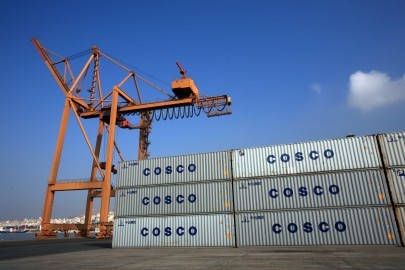
Along more than 20 miles of coastline outside Athens, a forest of cranes at the Piraeus port load and unload thousands of containers from China and around the world. An ultramodern floating dock is scheduled for arrival in November from China. A planned Chinese-financed passenger hub is also in the works.
China has transformed Piraeus into the Mediterranean’s busiest port, investing nearly half a billion euros through the state-backed shipping conglomerate COSCO. It hopes to make Piraeus the entry point to Europe under its One Belt, One Road project.
Chinese goods would travel along a new network of railways and roads radiating up through central European nations, with the prized destination being Germany, where China invested $12 billion last year alone.
COSCO has brought about 1,000 jobs to the area, but it has outfitted cargo docks with cranes made in China, not in Greece, and expanded the docks with building materials from China. And as Greece struggles through record joblessness, the company has used subcontractors to hire about 1,500 workers mostly on short-term contracts at wages far below what unionized Greek dockworkers are paid.
“There are more workers, but they earn less income,” said Giorgos Gogos, general secretary of the Piraeus dockworkers union.
Yet Greece needs any jobs, and leaders are counting on more Chinese investment. Fosun International Holdings, a Chinese conglomerate run by Guo Guangchang, often referred to as China’s Warren Buffett, is spending billions of euros with a consortium with Greek and Arab investors to convert an abandoned former airport on the seaside outside Athens into a posh playground three times the size of Monaco for moneyed tourists. The project, Hellenikon, is part of a bigger plan to bring more than 1.5 million Chinese tourists to Greece during the next five years.
Tsipras has swept aside regulatory hurdles, clearing two large refugee camps installed in the former airport, and quashing attempts by members of his own party to delay construction because of concerns the project might pave over ancient archaeological sites.
“That also has been unstuck,” said Dimitri B. Papadimitriou, the Greek economy minister.
Ask me anything
Explore related questions