






Human-like footprints have been found stamped into an ancient sea shore fossilised beneath the Mediterranean island of Crete.
They shouldn’t be there.
Testing puts the rock’s age at 5.7 million years.
That’s a time when palaeontologists believe our human ancestors had only apelike feet.
And they lived in Africa.
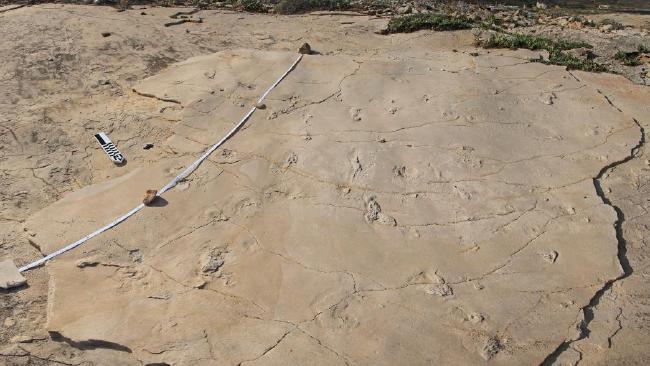
But a study into the Trachilos, western Crete, prints determines them to feature prominent human features and an upright stance.
And that’s significant as the human foot has a unique shape. It combines a long sole, five short toes, no claws — and a big toe.
In comparison, the foot of a Great Ape look much more like a human hand.
And that step in evolution wasn’t believed to have taken place until some 4 million years ago. Published in the latest edition of Proceedings of the Geologists’ Association, the study’s conclusions are bound to raise eyebrows in the human evolution community.
“The interpretation of these footprints is potentially controversial,” the study’s abstract admits.
“The print morphology suggests that the trackmaker was a basal member of the clade Hominini (human ancestral tree), but as Crete is some distance outside the known geographical range of pre-Pleistocene (2.5 million to 11,700 years ago) hominins we must also entertain the possibility that they represent a hitherto unknown late Miocene primate that convergently evolved human-like foot anatomy.”
Put simply, the study argues there was another — previously unidentified — human-like creature walking the Earth long before we believed it was possible. The existing pool of evidence into humanity’s origins is built around Australopithecus fossils found in south and East Africa, along with a 3.7 million-year-old set of upright hominin (human ancestor) footprints found in Tanzania.
RELATED: Mystery of the Kimberley dinosaur prints solved
Called the Laetoli footprints, these are believed to have been made by Australopithecus with a narrow heel and poorly defined arch.
In contrast, a set of 4.4 million-year-old prints found in Ethiopia are believed from the hominin Ardipithecus ramidus. These prints are much closer to that of an ape than a modern human.
But the Trachilos footprints, at 5.7 million years, appear to be more human than Ardipithecus.
They were found by the study’s lead author, Gerard Gierlinski, while he was holidaying on the island of Crete in 2002. The palaeontologist at the Polish Geological Institute has taken more than a decade to analyse his find.
The Trachilos prints have a big toe very similar to our own in size, shape and position. It has a distinct ball on its sole. It has the human-like sole. It doesn’t have claws.
They were pressed into the firm but wet sands of a small river delta at a time when the Sahara was lush and green, and savanna extended from North Africa around the Eastern Mediterranean. Crete itself was still part of the Greek mainland then.
They have been dated using foraminifera (analysis of marine microfossils) as well as their position beneath a distinctive sedimentary rock layer created when the Mediterranean Sea dried up about 5.6 million years ago.
The footprints’ discovery also comes shortly after the fragmentary fossils of a 7.2 million-year-old primate Graecopithecus, discovered in Greece and Bulgaria, were reclassified as belonging to the human ancestral tree.
source: news.com.au
These footprints, found at Trachilos in western Crete, have been attributed to an ancient human ancestor that walked upright some 5.7 million years ago. Credit: Andrzej Boczarowski
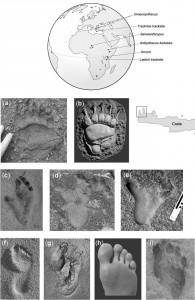
Comparison of Trachilos footprint with bears (top), non-hominin primates (middle), and hominins (bottom). (a) Brown bear (b) Grizzly bear (c) Vervet monkey (d) Lowland gorilla (e) chimpanzee. (f) modern human (g) Trachilos footprint (h) modern human foot (i) Archaic Homo footprint. Pictures: Gerard D. Gierliński et al / ElsevierSource:Supplied
Ask me anything
Explore related questions