

×
GreekEnglish

×
  • Politics
  • Diaspora
  • World
  • Lifestyle
  • Travel
  • Culture
  • Sports
  • Cooking
Tuesday
13
Jan 2026
weather symbol
Athens 9°C
  • Home
  • Politics
  • Economy
  • World
  • Diaspora
  • Lifestyle
  • Travel
  • Culture
  • Sports
  • Mediterranean Cooking
  • Weather
Contact follow Protothema:
Powered by Cloudevo
> technology

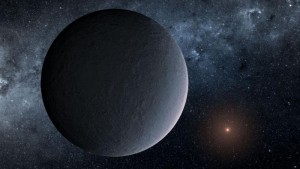
A giant exoplanet is hiding at the center of the Milky Way galaxy

The exoplanet has been given the clunky label OGLE-2016-BLG-1190Lb

Newsroom November 8 07:22


Scientists have spotted a gigantic exoplanet that they believe is hiding deep at the center of the Milky Way, about 22,000 light-years away from Earth, a large team is reporting in a paper recently posted on the physics pre-print server arxiv and submitted to The Astrophysical Journal.

The new planet orbits a star a little smaller than our own sun at about twice the distance that Earth orbits the sun. The exoplanet has been given the clunky label OGLE-2016-BLG-1190Lb, but don’t let the name bore you. It’s a little bigger than 13 Jupiters smooshed together, which means that for a planet, it’s really, really big—in fact, it may actually be large enough to be a tiny little star, what’s called a brown dwarf, instead.

Brown dwarfs are less charitably known as “failed stars” since they don’t actually have a stellar oven at their heart creating energy by fusing together atoms. But they’re still classified as a star because they produce light. The boundary between planet and brown dwarf falls right at 13 Jupiter masses, so given the scientists’ uncertainty about the new object’s precise size, it’s having a bit of an identity crisis.

But the scientists are actually less intrigued by its precise size than by how it formed: Traditionally, the things we call planets formed by lumps of stuff sticking together in a disk around a star, whereas stars are formed by a giant cloud of gas breaking down into stars.

Astronomers are particularly intrigued by the new planet because it is tucked deep in the heart of the Milky Way, in what’s called the galactic bulge. Usually, it’s hard to spot planets in this region since they’re tens of thousands of light-years away and don’t produce light.

>Related articles

Elon Musk: Don’t save for retirement – It won’t matter

Erich von Däniken, Swiss bestselling author who linked ancient civilizations to extraterrestrials, dies at 90

Sick astronaut on mission – NASA considers early return of International Space Station crew

The scientists were able to spot the planet by using a technique called microlensing, the only approach that allows them to spot planets deep in the galaxy’s heart. If a very large cosmic object with a very strong gravity, like a star, lies between Earth and a target, it bends the light of the distant object. That pattern varies when the distant star is accompanied by a planet. So scientists are able to work backward from what they know of the distant star and how its light changes to figure out precisely what’s coming between it and Earth.

NASA’s Spitzer Space Telescope, which has been chasing Earth in orbit around the sun for 14 years, has helped spot exoplanets before using the same microlensing technique.

Source: yahoo.com

Ask me anything

Explore related questions

#astronomy#brown dwarfs#center#discovery#distance#earth#exoplanets#galaxy#giant#hiding#journal#Milky Way#nasa#orbit#planets#science#space#space exploration#star#technology#telescopes
> More technology

Follow en.protothema.gr on Google News and be the first to know all the news

See all the latest News from Greece and the World, the moment they happen, at en.protothema.gr

> Latest Stories

Athens Stock Exchange: Maintains 16-year highs – Buyers insist for fifth day

January 13, 2026

Vienna airport closed due to frost, “very limited operation” at Prague airport

January 13, 2026

And formally the end of the line for Tsantali: the historic winery in bankruptcy

January 13, 2026

New farmers’ demonstration in Paris against the EU-Mercosur agreement

January 13, 2026

Germany sees no immediate threat of U.S. military annexation of Greenland

January 13, 2026

Marinakis calls for enforcement as blockades disrupt Greece – Blames party-backed minority for derailing talks

January 13, 2026

Seven challenges that will dominate global health in 2026

January 13, 2026

Open confrontation between the Association of the victims of Tempi and Karystianou: “She had to resign” – “I will leave if the assembly asks me to”

January 13, 2026
All News

> Politics

Marinakis calls for enforcement as blockades disrupt Greece – Blames party-backed minority for derailing talks

"Let this minority - certainly including the KKE - understand that 2026 is not 1996 or 2006. Gone are the days of general assemblies, the people must move forward"

January 13, 2026

Open confrontation between the Association of the victims of Tempi and Karystianou: “She had to resign” – “I will leave if the assembly asks me to”

January 13, 2026

Government turns tough on farmers’ unions as talks collapse again

January 13, 2026

Mattel releases the first Barbie with autism, watch video

January 12, 2026

Russia declares war on the Ecumenical Patriarch: “He is dismantling the Body of the Church, has nationalist and neo-nazi allies”

January 12, 2026
Homepage
PERSONAL DATA PROTECTION POLICY COOKIES POLICY TERM OF USE
Powered by Cloudevo
Copyright © 2026 Πρώτο Θέμα