





To fight traffic congestion, pollution and other challenges that plague modern cities, an increasing number of French towns are choosing to make their public transport networks completely free.
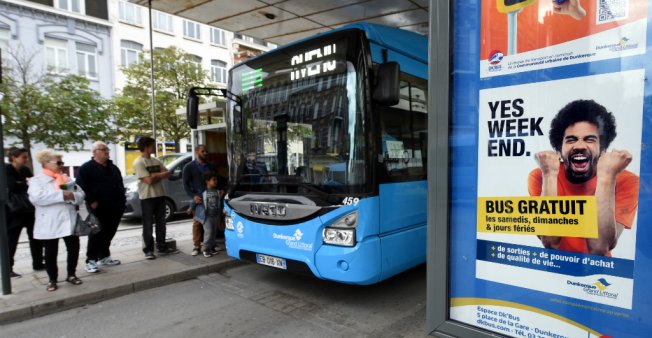
A few months ago, the northern French town of Dunkirk made headlines by announcing that all of its buses would be free all the time as of next September. The gritty seaside town with a population of over 90,000 (but whose public transport network extends to 200,000) will then become the largest of over 20 other French towns and cities to offer completely or partially free public transport.
With this scheme, the mayor of Dunkirk hopes to provoke nothing less than a transport ‘revolution’.
“We wanted a transport revolution,” Patrick Vergriete told Le Parisien. “Not only are we redistributing spending power, but we are getting rid of inequalities by providing better access to jobs and leisure facilities,” he said. “We are strengthening the social fabric and there is also an ecological impact.”
Dunkirk, France has made all its public transport free to motivate more people to take buses, and avoid driving! https://t.co/5c536uSA04
— 10:10 climate action (@1010) October 31, 2017
Fifteen towns have scrapped all fees
To date, 15 towns in France have scrapped fees on their public transport networks completely. The small town of Compiègne near Paris led the way in 1975, and gradually, other, larger towns followed suit. Niort in western France was the latest to sign up to the scheme this summer.
Proponents of free public transport say the schemes encourage people to use public transport instead of cars; that they can boost economic activity in the town centres and that they can provide a viable long-term solution for the car-free cities of the future. Time for planning cities without today’s cars could be running short. Last month, the French government announced that sales of all petrol and diesel cars would be banned from 2040 and in Paris from 2030.
To date, many towns appear to have reaped the benefits of making their public networks free.
After bus tickets were scrapped during the weekends in Dunkirk in 2015, a study found that the number of users increased by an average of 5,000 users daily. Families, young people and the elderly were found to benefit the most.
“Since we made buses free at the weekend in 2015, anti-social behaviour has decreased by 60 percent, 29 percent more people come on Saturdays and 78 percent on Sundays, and it only costs us €4.5 million, which is what we are no longer getting from ticket sales,” Patrick Vergriete said. “The cities that have chosen to do this have never looked back.”
“Impossible to turn back”
Compiègne, France’s free public transport pioneer, has had no regrets. “It’s provided a real social and economic boost for businesses and for households,” the town’s mayor Nicolas Leday told Le Monde. “People have got so used to it that it’s impossible to turn back.”
In this small elegant town 90 kilometres north of the French capital, businesses have been key to the scheme’s success. For free public transport comes at a cost: in Compiègne, it’s €5.7 million a year. The city compensates for the shortfall in ticket sales by taxing all companies that employ more than 11 people. Leday says companies do this willingly because their employees benefit from the scheme.
But not all cities have been as successful. A few years ago across the border in Belgium, the city of Hasslet – which provided free buses for 16 years – brought back fares because the town could not afford it anymore.
“The issue of free transport is very divisive,” said Henri Briche, the author of a study on Dunkirk’s free public transport scheme. “It does not provide a miracle solution, but it’s a first step towards solving problems of movement and access to jobs.”
French towns with completely free public transport
– Castres (since 2008)
– Chantilly (since 1992)
– Châteaudun (since 2009)
– Châteauroux (since 2001)
– Crépy-en-Valois (since 2011)
– Figeac (since 2003)
– Gaillac (since 2014)
– Issoudin (since 2002)
– Mayenne (since 2002)
– Niort (since 2017)
– Noyon (since 2008)
– Nyons (since 2011)
– Pont-Sainte-Maxence (since 2006)
– Saint-Brévins-les-Pins (since 2008)
– Senlis (since 2000)
‘Psychological shock’
The French national transport network GART believes that free transport is the wrong way forward. It advocates fares that are means tested instead.
“It’s important to remember that even if transport is free for users, it is not for the city. When users don’t pay, it has to compensate for those losses,” GART said in a statement. “In order to help people with fewer means, we would prefer fees to be income-based rather than fares based on the sole status of being an individual.”
The mayor of Dunkirk is convinced that the way forward is to go free: “We could have opted for a means-tested solution. But it wouldn’t have provided the necessary psychological shock.”
Source: france24.com
Ask me anything
Explore related questions


