




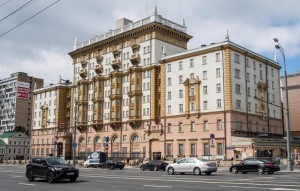
When President Vladimir V. Putin in July ordered American diplomatic missions in Russia to slash their staff by 755 employees, the State Department said it would need time to assess the “impact of such a limitation and how we will respond to it.”
Part of that response has now become clear: To make up for the loss of security guards axed in the Russian-mandated staff cuts, Washington has hired a private Russian company that grew out of a security business co-founded by Mr. Putin’s former K.G.B. boss, an 82-year-old veteran spy who spent 25 years planting agents in Western security services and hunting down their operatives.
Under a $2.8 million no-bid contract awarded by the Office of Acquisitions in Washington, security guards at the American Embassy in Moscow and at consulates in St. Petersburg, Yekaterinburg and Vladivostok will be provided by Elite Security Holdings, a company closely linked to the former top K.G.B. figure, Viktor G. Budanov, a retired general who rose through the ranks to become head of Soviet counterintelligence.
A State Department official in Washington, speaking on condition of anonymity in accordance with the department’s rules, said that Elite Security and individuals associated with it had been “vetted” with “relevant national and local agencies” and would not increase the threat risk.
“U.S. missions around the world work constantly under intelligence and physical security threats,” the official said. “This contract does not change that fact.”
Russian company records show that Mr. Budanov, who retired from espionage in 1992 after becoming upset by Russia’s direction under its first post-Soviet leader, Boris N. Yeltsin, is a former minority owner of at least three of Elite’s branches — in Moscow, in the Volga region and in western Russia. Records indicate that he no longer holds any ownership stake, but Kommersant, a Russian business newspaper, has reported that the company’s head office in Moscow is run by his son, Dimitri.
Elite Security, reached by telephone in Moscow, declined to comment on the role in the company of Mr. Budanov and his son.
Marines will continue to guard American diplomatic missions, but tasks previously handled by local guards hired directly by the embassy in Moscow, like screening visitors, will be taken over by Elite Security employees. Hiring guards directly allowed closer monitoring of their backgrounds, but any Russian working for an American diplomatic mission, no matter how closely screened, is vulnerable to pressure from Russia’s state security apparatus.
Local guards are mostly restricted to the perimeter of diplomatic compounds and do not generally have access to secure areas.
An official note about the no-bid contract posted on a United States government website says that American companies had been contacted about taking on the security job in Russia but that “no U.S. firm has been located with the requisite licensing or desire to operate in-country.” It added that, among Russian companies that could do such work, only Elite Security had established operations and licenses to operate in the four cities where American missions needed guards.
The note said that Russia’s decision to insist on personnel cuts at American diplomatic missions in Moscow and elsewhere had created a “compelling urgency” to find new guards, and that doing so through a commercial contract was “the only available option.”
“This is very good for us,” said Mikhail Lyubimov, a former K.G.B. spy who knew Mr. Budanov from their time together in the Soviet intelligence service. “If I were the chief there, I would never do this for a very clear reason,” he said, adding that the Russian Embassy in Washington would not put security in the hands of an American company known to have ties to the C.I.A.
Like many former Soviet security officers, Mr. Budanov went into the private sector after the collapse of communism in the Soviet Union in 1991. He formed a joint venture with Gerard P. Burke, who was once assistant director of the National Security Agency, and headed the Moscow office of Parvus International, a business intelligence firm in Silver Spring, Md., founded by Mr. Burke, that employed former C.I.A., K.G.B. and Soviet-bloc agents.
Mr. Budanov started out in Soviet intelligence in the 1960s as a lowly officer whose work included buying food and other provisions for Kim Philby, the notorious British double agent who defected to Moscow in 1963 and died there in 1988.
In the late 1960s, Mr. Budanov was posted by the K.G.B. to Britain, which expelled him in 1971 as part of a mass clean-out of those suspected of spying for the Soviet Union.
He then rose to head the K Directorate of the K.G.B., a sprawling division that hunted for double agents recruited by the West and sought to penetrate the C.I.A. and other hostile foreign agencies. Toward the end of his espionage career, he worked for the K.G.B. in East Germany, serving there during the same period as Mr. Putin, who was then a junior K.G.B. officer in Dresden.
In interviews with Russian news media, Mr. Budanov declined to discuss his time working with Mr. Putin but has voiced great admiration for his former colleague’s subsequent role as president, crediting him with saving Russia from the chaos of Mr. Yeltsin’s rule.
In a 2007 interview, Mr. Budanov claimed credit for helping to expose Oleg Gordievsky, a Soviet diplomat based in London, as a British spy, but he denied that the K.G.B. assassinated people suspected of being traitors during his time in service. Mr. Gordievsky, who was recalled to Russia in 1985 to face almost certain execution, escaped to the West while under investigation and later wrote a book in which he described Mr. Budanov as one of the K.G.B.’s most dangerous men.
Mr. Budanov said that being referred to in that way by “an enemy agent” had “helped me back then, and it still helps me do my work today.”
Source: nytimes.com
Ask me anything
Explore related questions