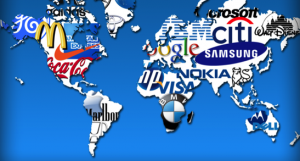
A quarter-century of global liberalization and integration appears to be on knife’s edge. Over the past two decades, global capital markets, technological connectivity and the growth of new consumer markets worldwide have given rise to massive corporate platforms in commodities, finance, information technology, retail and other sectors. The scale of entities such as Google, Facebook, Walmart, and GE have made them appear almost stateless as they operate on a global playground.
But these stateless superpowers are also primarily American companies facing new pressures that will impact their global strategies. First, US president Donald Trump’s intimidation of American business to near-shore production, coupled with border adjustment taxes and other protectionist measures, will likely invite retaliatory measures from other countries, most prominently China. This could raise costs and erode profits for multinationals across the board, especially those invested in complex global supply chains.
Second, governments are stepping in to regulate global platform firms such as Uber and Airbnb who have either flouted or exploited the lack of relevant regulation thus far, with local industry groups and lobbies rebelling to curtail their unlicensed and non-taxed profit making. Even incumbent information behemoths such Apple, Google, Amazon, and Facebook are taking flack from all directions: Trump is pushing them to repatriate an estimated $1.5 trillion held offshore, Europe is litigating against their monopolies, privacy policies and cost-free republishing of news, and China strengthening its firewalls and local data storage requirements.
Moving forward, the fate of these stateless superpowers will be much more complex than the road taken to their current scale. Contrary to the prevailing view that America’s global firms will cave to White House pressure, the opportunities presented by global markets—even fragmented ones—will push them to “go local” everywhere, anchoring themselves in each market to comply with domestic requirements. They will reorganize to become, in effect, holding companies or federations of internationally distributed firms.
Uber is an unfolding case study of perpetual local adaptation. In China, Uber entered a sale-cum-merger with Didi Chuxing to stem its losses and raise capital for global investment, while in other countries, it responds differently to national requirements around driver registration and data-sharing. Data nationalism is having a significant impact and tech companies will have to bend to the strong-arming of foreign governments on matters such as source code (which IBM has provided to China), or hosting more data onshore. As Amazon and Microsoft compete for the cloud market worldwide, their degree of compliance with foreign data regulations may determine victory in each battleground.
America, quite frankly, is a latecomer to the new industrial policy landscape in which emerging markets have become increasingly sophisticated players. Trump’s trade and regulatory proposals invite a multi-directional reciprocity, a heightened tug-of-war over global value chains. As manufacturing is near-shored back to America, the large export markets on which these companies depend for revenue and profits—and on which their share price at home depends—will continue to use non-tariff barriers to ensure that what is sold in their markets is increasingly made on their home turf as well.
Indeed, inspired by China’s decades-long success as the world’s factory floor, the #MakeInIndia campaign has forced America’s largest defense contractors such as Lockheed Martin into joint ventures in order to gain lucrative contracts. It has also raised the bar for Apple to be granted permission to open flagship stores in the country. Meanwhile, China’s Xiaomi and India’s MicroMax are gaining ground across Asia. Make no mistake of Asia’s intentions: Soon Western companies will seek to be part of Chinese and Indian supply chains rather than the reverse. This is what chip makers such as Qualcomm are already focused on.
There are other repercussions of an increasingly fragmented regulatory landscape that are driving companies to re-root themselves abroad, in search of greener pastures, as it were. After the US Congress failed to renew the Export-Import Bank charter in 2015, GE shifted several hundred turbine manufacturing jobs to France while gaining regulatory approval to buy Alstom’s power division. GE’s focus now varies across continents, with different geographies emphasizing manufacturing, energy and software systems. Emerging financial centers such as Singapore and more recently Dubai are increasingly aggressive in courting financial services and tech companies to establish joint ventures in their favorable jurisdictions.
Firms may also be motivated by more progressive or experimental regulatory frameworks. Domino’s Pizza, for example, has started testing aerial pizza delivery via drones in New Zealand, in partnership with drone operator Flirtey. These two US companies have their eyes fixed on seven non-US markets with more favorable drone regulations. Amazon has similarly chosen the UK to test delivery drones.
Emerging markets are also finding ways to crack down on multinational transfer pricing as vociferously as the US Congress and regulators seek to crack down on inversions. From India to Indonesia, governments have ramped up audits, raised capital gains taxes, and demand country-by-country reporting on profits and tax payments in order to strengthen local presence. In almost all cases, companies comply to retain access to fast-growing markets. In effect, host governments want foreign investors to act like private equity firms that capitalize local companies and operate through joint ventures or special purpose vehicles whereby cash is held onshore for longer.
Indeed, in the long run, the fragmentation of regulation likely implies the morphing of global companies themselves into new governance and operating structures. One possible model is to have the company organized as affiliated networks of independently operating, locally registered, privately held partnership structures to avoid anti-foreign backlash. We are entering an important phase where the choices of regulators will determine the geography of business and innovation more than the presence of technology and talent. The policy choices we make over the next few years will change not just the structure of future global businesses but also the competitiveness of entire nations.
Source: qz
Ask me anything
Explore related questions