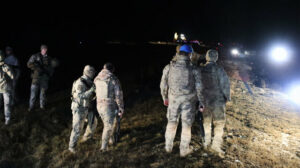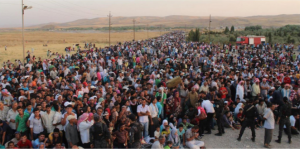
In recent years, Europe has experienced a record influx of asylum seekers fleeing conflicts in Syria and other predominantly Muslim countries. This wave of Muslim migrants has prompted debate about immigration and security policies in numerous countries and has raised questions about the current and future number of Muslims in Europe.
To see how the size of Europe’s Muslim population may change in the coming decades, Pew Research Center has modeled three scenarios that vary depending on future levels of migration. These are not efforts to predict what will happen in the future, but rather a set of projections about what could happen under different circumstances.
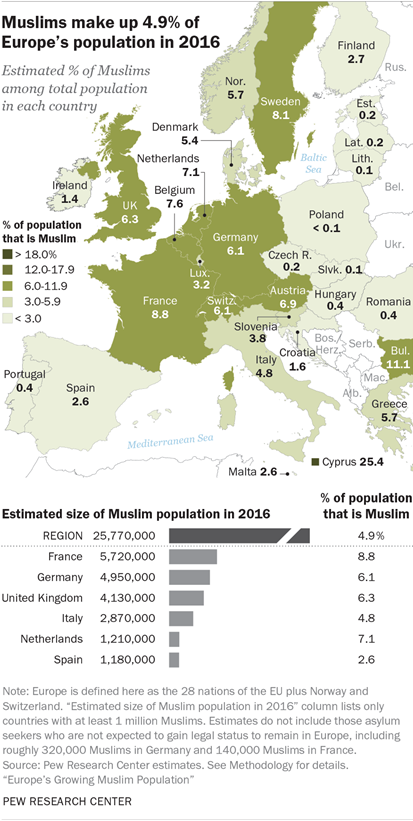
The baseline for all three scenarios is the Muslim population in Europe (defined here as the 28 countries presently in the European Union, plus Norway and Switzerland) as of mid-2016, estimated at 25.8 million (4.9% of the overall population) – up from 19.5 million (3.8%) in 2010.
(Click images to enlarge)
Even if all migration into Europe were to immediately and permanently stop – a “zero migration” scenario – the Muslim population of Europe still would be expected to rise from the current level of 4.9% to 7.4% by the year 2050. This is because Muslims are younger (by 13 years, on average) and have higher fertility (one child more per woman, on average) than other Europeans, mirroring a global pattern.
A second, “medium” migration scenario assumes that all refugee flows will stop as of mid-2016 but that recent levels of “regular” migration to Europe will continue (i.e., migration of those who come for reasons other than seeking asylum; see note on terms below). Under these conditions, Muslims could reach 11.2% of Europe’s population in 2050.
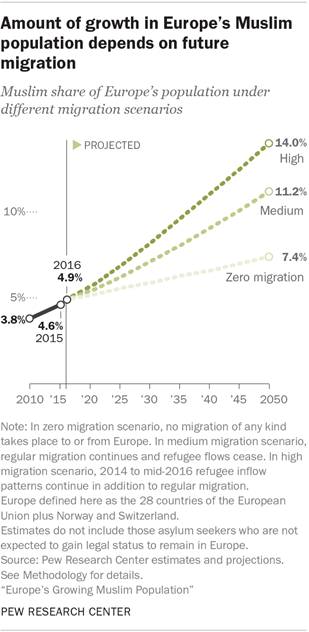
Finally, a “high” migration scenario projects the record flow of refugees into Europe between 2014 and 2016 to continue indefinitely into the future with the same religious composition (i.e., mostly made up of Muslims) in addition to the typical annual flow of regular migrants. In this scenario, Muslims could make up 14% of Europe’s population by 2050 – nearly triple the current share, but still considerably smaller than the populations of both Christians and people with no religion in Europe.
The refugee flows of the last few years, however, are extremely high compared with the historical average in recent decades, and already have begun to decline as the European Union and many of its member states have made policy changes aimed at limiting refugee flows (see sidebar).
Predicting future migration levels is impossible, because migration rates are connected not only to political and economic conditions outside of Europe, but also to the changing economic situation and government policies within Europe. Although none of these scenarios will play out exactly as projected, each provides a set of rough parameters from which to imagine other possible outcomes. For example, if regular migration continues at recent levels, and some asylum seekers also continue to arrive and receive refugee status – but not as many as during the historically exceptional surge of refugees from 2014 to 2016 – then the share of Muslims in Europe’s population as of 2050 would be expected to be somewhere between 11.2% and 14%.

While Europe’s Muslim population is expected to grow in all three scenarios – and more than double in the medium and high migration scenarios – Europe’s non-Muslims, on the other hand, are projected to decline in total number in each scenario. Migration, however, does mitigate this decline somewhat; nearly half of all recent migrants to Europe (47%) were notMuslim, with Christians making up the next-largest group.
Taken as a whole, Europe’s population (including both Muslims and non-Muslims) would be expected to decline considerably (from about 521 million to an estimated 482 million) without any future migration. In the medium migration scenario, it would remain roughly stable, while in the high migration scenario it would be projected to grow modestly.
The impact of these scenarios is uneven across different European countries (see maps below); due in large part to government policies, some countries are much more affected by migration than others.

Countries that have received relatively large numbers of Muslim refugees in recent years are projected to experience the biggest changes in the high migration scenario – the only one that projects these heavy refugee flows to continue into the future. For instance, Germany’s population (6% Muslim in 2016) would be projected to be about 20% Muslim by 2050 in the high scenario – a reflection of the fact that Germany has accepted many Muslim refugees in recent years – compared with 11% in the medium scenario and 9% in the zero migration scenario.
Sweden, which also has accepted a relatively high number of refugees, would experience even greater effects if the migration levels from 2014 to mid-2016 were to continue indefinitely: Sweden’s population (8% Muslim in 2016) could grow to 31% Muslim in the high scenario by 2050, compared with 21% in the medium scenario and 11% with no further Muslim migration.
By contrast, the countries projected to experience the biggest changes in the medium scenario (such as the UK) tend to have been destinations for the highest numbers of regular Muslim migrants. This scenario only models regular migration.
And countries with Muslim populations that are especially young, or have a relatively large number of children, would see the most significant change in the zero migration scenario; these include France, Italy and Belgium.
Some countries would experience little change in any of the scenarios, typically because they have few Muslims to begin with or low levels of immigration (or both).
The starting point for all these scenarios is Europe’s population as of mid-2016. Coming up with an exact count of Muslims currently in Europe, however, is not a simple task. The 2016 estimates are based on Pew Research Center analysis and projections of the best available census and survey data in each country combined with data on immigration from Eurostat and other sources. While Muslim identity is often measured directly, in some cases it must be estimated indirectly based upon the national origins of migrants (see Methodology for details).

More at pewforum
Ask me anything
Explore related questions