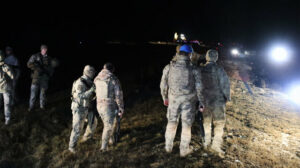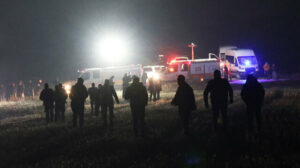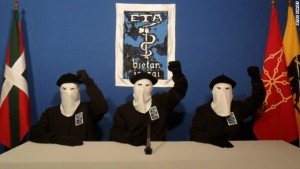
Basque separatist group ETA waged its worst years of violence just as Spain celebrated its newfound freedom following the 1975 death of Francisco Franco.
A euphoric, hedonistic time famously depicted in Spanish director Pedro Almodovar’s films, that period was also marked by scenes of devastation as car bombs went off and fathers, mothers, husbands or wives were murdered.
Attacks
Founded in 1959, ETA targeted police officers, politicians and representatives of state firms, but also civilians in its campaign of bombings and shootings to create an independent state in northern Spain and southwest France.
It left at least 829 people dead.
The number of attacks carried out by the group soared after Franco’s death, according to a study carried out by the University of the Basque Country.
Between 1968 and 1975, ETA killed 43 people. Then up to 2010 its attacks claimed 786 lives in Spain and France.
From 1981 to 1991, an average of one person was killed every 10 days.
“It was like living a nightmare,” said Eduardo Madina, a former Socialist lawmaker from the Basque region who lost a leg during an ETA car bomb attack in 2002 when he was 26.
“There was a subculture of violence that led part of my generation to find it acceptable… and we’re talking about a lot of people, nearly 200,000 people, 12 percent of the (Basque) population.”
ETA’s attacks were met with counter attacks by shadowy death squads such as the state-sponsored Anti-terrorist Liberation Groups (GAL) which killed 27 people.
The conflict caused a total of 914 deaths, the vast majority by ETA or its offshoots, according to the study.
Kidnappings
Like the radical left-wing Red Brigades in Italy, ETA kidnapped business owners to finance its activities. The abductions also sought to silence dissidents.
A total of 86 people were kidnapped by ETA or groups close to it, according to the study. It estimates the abductions raised 38.5 million euros ($46.7 million) in ransoms.
Some kidnappings were especially traumatic for Spaniards, such as that of Jose Antonio Ortega Lara, a prison officer who spent 532 days in a tiny damp cell in 1996 and 1997.
Or that of Miguel Angel Blanco, a 29-year-old councillor, in 1997.
The entire country waited anxiously for the expiry of a 48-hour ultimatum for Madrid to move 500 ETA prisoners held in jails across Spain closer to the Basque Country.
He was killed, shot twice in the back of the head.
Hundreds of thousands of people marched through the streets across Spain in protest, crying “murderers” and the movement “Basta ya”, or “That’s Enough” was born.
Street fighting
Youths linked to ETA carried out a relentless campaign of “kale borroka”, or street violence, in the Basque Country to keep the pressure up by setting off small bombs that destroyed bank machines or other property without causing injuries.
Anti-independence activists were silenced.
“Because I wore a Spanish flag on my wrist, they beat me up,” said Inaki Oyarzabal, a Basque senator with the conservative Popular Party who was a teenager at the time.
Students would drop out of classes in the middle of the school year “without any explanation” because their familes were leaving the region after receiving threats, he added.
Extortion
ETA is thought to have extorted nearly 10,000 people, according to a study by the University of Deusto in the Basque seaside town of San Sebastian.
Business leaders who refused to pay up received threatening letters from ETA.
Police violence and torture
Security forces also carried out a “dirty war” campaign of executions, kidnappings and torture in the Basque Country against ETA.
ETA collaborator Encarni Blanco and her husband were arrested in 1982 by Spain’s Guardia Civil police force on their return from their honeymoon.
They were punched and received electric shocks while their heads were covered with a hood during five days of police custody.
“You cannot lie down, you cannot sleep, you do not know what time it is, you do not know if it’s night, day… And in the end you fall apart… (you say) ‘what do you want from me, I will do what you want because I want to escape this hell’,” she recalled later.
According to a December report commissioned by the Basque regional government, more than 4,100 complaints of police torture were made between 1960 and 2014.
Source: france24
Ask me anything
Explore related questions