




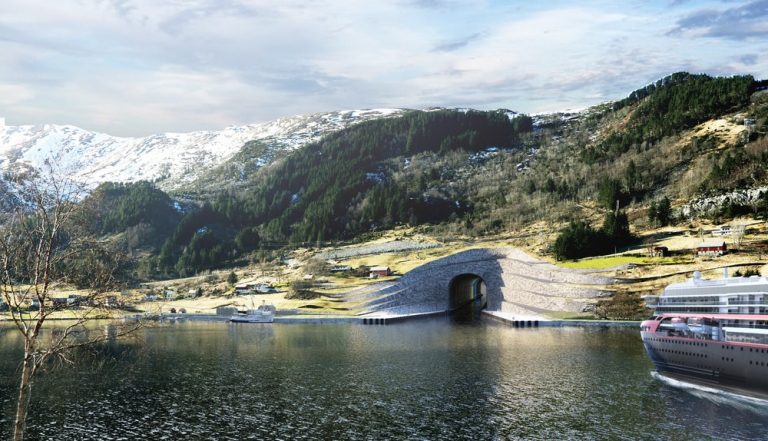
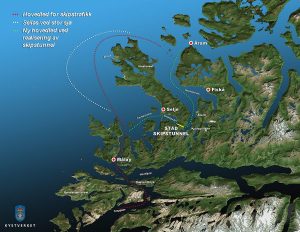
Norway’s most hazardous shipping route passes around the country’s Stad peninsula and harsh local weather means delays and dangerous conditions for ship crews are a regular occurrence. An ambitious plan aims to solve this by building the world’s first ship tunnel of any significant size directly through the peninsula, enabling ships to travel in safety. We recently interviewed Stad Ship Tunnel Project Manager Terje Andreassen about the project.
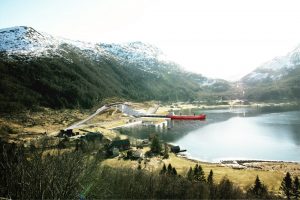
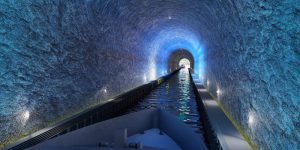
Assuming it does indeed go ahead – and with the Norwegian government having already set aside the money, this seems relatively likely – the Stad Ship Tunnel will reach a length of 1.7 km (1.05 miles), and measure 37 m (121 ft) tall and 26.5 m (87 ft) wide.
It’s expected to cost NOK 2.3 billion (over US$272 million) to build and won’t actually speed up travel times, but instead focuses on making the journey safer.
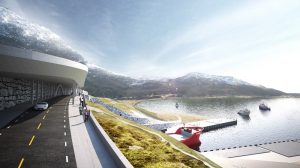
Top-tier architecture and design firm Snøhetta has designed the entrances, and the company’s early plans include sculpted tunnel openings and adding LED lighting on the tunnel ceiling.
Without further ado, here’s our chat with Terje Andreassen, a construction engineer with 20 years experience of project management. The last four years as an employee at Kystverket (Norwegian Coastal Administration).
New Atlas: What’s the basic goal of the Stad Ship Tunnel project?
The basic goal is to make a safer alternative for sailing past the dangerous water outside the Stad peninsula, and reduce waiting time for vessels during harsh weather.
NA: The scale and cost of the project are both pretty significant, so presumably the existing route must be very hazardous to make it worthwhile?
Yes, this is the most hazardous part of the Norwegian coastline with more than 100 days of storm/hurricane yearly. The combination of the underwater topography, current and the most stormy area along the coastline makes big and choppy waves which often is a challenge to handle.
NA: How many ships will pass through on average? Presumably it’s one-way traffic?
In average there will pass 19 ships a day. The tunnel has a capacity of 100 ships a day. There will be one-way traffic which will alternate every hour. The traffic will be controlled by one of our vessel traffic centers and slot times will be given to all commercial vessels.
NA: We’d usually expect a canal to be built for this kind of purpose, so why a tunnel?
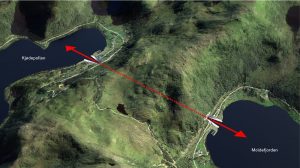
Because in this case we are crossing a hill which is more than 300 m (984 ft) high. The only alternative is a tunnel. From a maritime point of view this is still a canal, but with a “roof.”
NA: Presumably tourism and jobs could be boosted but what other benefits will the tunnel bring?
It will have a huge effect for the fish industry. There is a lot of transport of fish in this area and the Stad sea is a hinder for both transport of living fish from fish farms and caught fish. It will make all transport of goods more predictable. It will also be possible to establish speed passenger ferries between Bergen and Ålesund.
This is not possible today because of the hazardous conditions outside the Stad peninsula. Also for larger passenger vessels, like the coastal steamer (Hurtigruten), there will be a more comfortable journey for passengers.
NA: How would you go about making such a large tunnel – would you use a boring machine, for example, or explosives?
First we will drill horizontally and use explosives to take out the roof part of the tunnel. Then all bolts and anchors to secure the roof rock before applying shotcrete. The rest of the tunnel will be done in the same way as in open mining. Vertical drilling and blasting with explosives down to the level of 12 m (42 ft) below the sea level.
NA: How much rock will be removed, and how will you go about removing it?
There will be 3 billion cubic meters (over 105 billion cubic ft) of solid rock removed. All transportation from the tunnel area will be done by large barges.
NA: What, if any, are the unique challenges to building a ship tunnel when compared with a road tunnel?
The challenge is the height of this tunnel. There is 50 m (164 ft) from bottom to the roof, so all secure works and shotcrete must be done in several levels. The tunnel will be made dry down to the bottom. We solve this by leaving some rock unblasted in each end of the tunnel to prevent water flowing in.
NA: How many people will work on it and how long will it take?
I assume that on average 80 people will be engaged in labor work for 3-4 years.
NA: Finally, how likely is it that the Stad Ship Tunnel project will actually go ahead?
The project is now in “the national transportation plan,” so it is likely that it will go ahead.
Source: newatlas
Ask me anything
Explore related questions