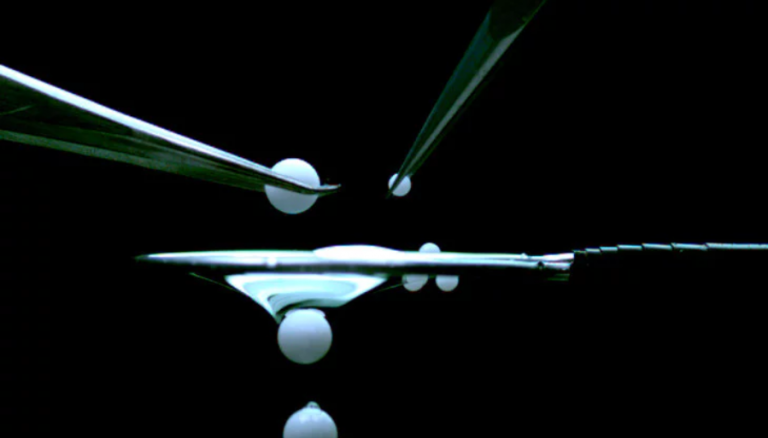
A “straight out of science fiction” liquid membrane developed by a team of Penn State mechanical engineers acts as a “reverse filter” that lets large objects through while blocking small ones. The self-healing, stabilized liquid material, which mimics many of the properties of a cell membrane, acts counter-intuitively as the polar opposite of a conventional sieve.
Filters and sieves are amongst the simplest and easiest to understand tools that there are. If you fill up a sieve with, for example, castor sugar and dried peas, then give it a shake, the holes in the sieve will allow the fine sugar particles to flow through, leaving behind the relatively large peas. It’s a principle that we use in everything from coffee filters to highly sophisticated purification systems.
But what if it was possible to create a filter that worked in exactly the opposite way? One that let the peas through, yet left behind the sugar? That is the idea behind the Penn State team’s research, which uses a variety of liquid membranes to create reverse filters.
The basic idea is that these membranes are suspended in a ring, like soap solution in a bubble blowing toy. These membranes are self-healing, much like the layer of surface tension on the top of a glass of water. That is, if you poke a finger or other object through the membrane, it closes around it. Remove the object, and the hole closes up.
But the clever bit is that such membranes can also let large objects through while blocking smaller ones. This is because instead of using holes in the membrane for separation, the membrane uses the object’s kinetic energy as it hits the membrane.
“Typically, a smaller object is associated with lower kinetic energy due to its smaller mass,” says Tak-Sing Wong, the Wormley Family Early Career Professor and assistant professor of mechanical and biomedical engineering. “So, the larger object with a higher kinetic energy will pass through the membrane, while the smaller object with lower kinetic energy will be retained.”
Formed by water and one of a variety of substances that stabilizes on the interface between liquid and air, the membrane is similar to that of a living cell in structure, with the first prototypes being formed from (not surprisingly) soap. This was later modified to make it stronger as well as giving it antibacterial and odor-neutralization properties. It can also be made longer lasting or impermeable to certain gases.
The Penn State team sees a variety of applications for the new membrane once perfected. It could, for example, be used as a surgical film in disaster areas or battlefields to avoid infection. Because it’s self-healing, it could even act as a sort of mini operating room, which could be set over a wound while surgeons pass their instruments through the membrane while the germs are left behind.
“The membrane filter could potentially prevent germs, dust or allergens from reaching an open wound, while still allowing a doctor to perform surgery safely,” says Wong. “This membrane could make this possible.”
The research was published in Science Advances. The video below shows the reverse filter in action.
Source: newatlas
Ask me anything
Explore related questions