





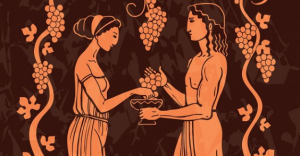
The word, aphrodisiac has its roots in Ancient Greece and comes from the name of the Greek Goddess of love and beauty, Aphrodite, who, according to Greek mythology, was born from the sea, and swept to shore in a scallop or oyster shell.
Modern sexologists would scarcely put any real importance on old sexual potency foods or remedies.
But the ancient Greeks and Romans considered some specific types of foods as the perfect way to boost the libido.
Even the Olympian gods had their own ritual before every erotic act, which was, in fact, a dinner full of passion and pleasurable foods that opened up the appetite for … bed.
An aphrodisiac is a substance that increases libido, called by the ancient Greeks, philitron, a love charm, or, love potion.
So what were some of the aphrodisiacs the ancient Greeks ate to keep them in the right mood?
1. Saffron
Aristotle, the great Greek philosopher, swore by saffron, to do the job, and added it to all his food, just to help him go that extra mile.
Saffron, the most expensive spice in the world, and the most potent of aphrodisiacs, the stamen of the crocus flower, has now been scientifically proven, to be a powerful aphrodisiac, and may even outperform synthetic substances.
2. Artichokes
It is said, in Greek mythology, artichokes were created by Zeus, when he was rejected by a beautiful woman, who he consequently turned into an artichoke, prickly and hard on the outside, soft inside.
Artichokes were thought to ensure the birth of a son; maybe that Greek housewife you spotted at the market, with bags full of artichokes, has four daughters and longs for a son?
3. Lentils
Hippocrates, father of medicine, urged his fellow men to eat heaps of lentils, to keep them “Manly” into their old age.
4. Beans
Plutarch, put his trust in beans and virtually lived on “Fasolada”, a soup made from dry, white beans, which, incidentally, is today’s Greek national dish!
5. Mushrooms and Truffles
The rich, musky aroma of truffles, mimic that of pheromones, a chemical in the body which attracts the opposite sex.
6. Onions
Onions have been mentioned many times in ancient history, as an aphrodisiac, not only by the Greeks, but, by the ancient Egyptians, Arabs, Persians and Romans.
Priests were forbidden to consume onions, in order for them to remain celibate.
An old French tradition, advises newly married couples, to partake of onion soup, the day after their wedding, to renew their passion
7. Garlic
Homer, the famous Greek poet, daily consumed plenty of garlic, most likely in the form of “Skordalia” a paste of garlic and bread, or “Tzatziki”, yoghurt with lashings of garlic, both dishes still favoured today in Greece, mostly by men I might add, a coincidence?
Garlic, since ancient times, has been known for its magical, medicinal powers.
8. Bay or Laurel leaves
The bay, or laurel leaf, a symbol of the Greek God Apollo, dates back thousands of years.
When taken as an infusion, it is mildly narcotic; it was taken by Greek priestesses, to achieve a trance – like state, necessary to predict the future.
When blended with oil, and used for massage, it aids the circulation, and promotes a strong blood flow.
9. Mint
Mint tea, consumed in great quantities throughout the Mediterranean and Arab world, really puts people in the mood, so to speak.
Aristotle advised Alexander the Great, not to allow his warriors to drink it, before going in to battle, as it would put other things on their mind and distract them.
10. Satyrion (Similar to wild orchid)
Judging from Greek and Roman accounts, satyrion must have been very close to the perfect aphrodisiac,
according to Theophrastus, it produced on one occasion seventy consecutive acts of sex!
Another Roman author suggests that it is sufficient to use it on the soles of the feet to produce erotic arousal,
or another source suggests that it was sufficient to hold a part of the plant in the hand to produce the desired erotic effects.
Unfortunately, the precise identity of satyrion is not known today. It was a plant with reddish leaves and a double root, possibly similar to the orchids producing salep.
The most common way of using it was to pulverize the dried root and add it to wine.
Satyrion was such a fast-acting stimulant, so effective, that its properties remained secret.
source: greekerthanthegreeks.com
Ask me anything
Explore related questions