

×
GreekEnglish

×
  • Politics
  • Diaspora
  • World
  • Lifestyle
  • Travel
  • Culture
  • Sports
  • Cooking
Thursday
15
Jan 2026
weather symbol
Athens 16°C
  • Home
  • Politics
  • Economy
  • World
  • Diaspora
  • Lifestyle
  • Travel
  • Culture
  • Sports
  • Mediterranean Cooking
  • Weather
Contact follow Protothema:
Powered by Cloudevo
> World

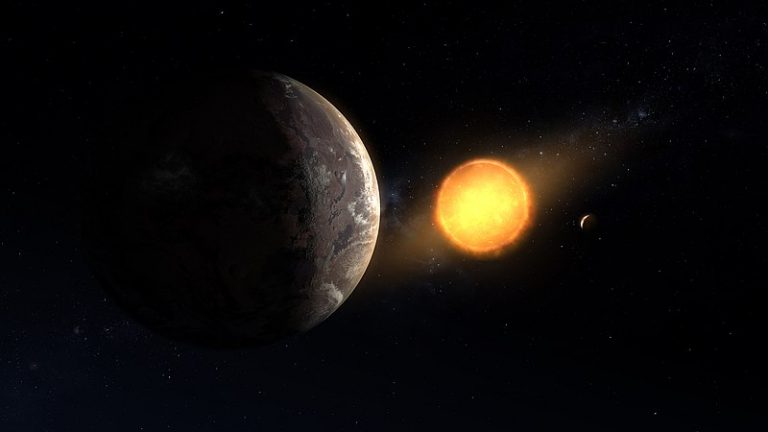
An exoplanet the size of Neptune discovered 32 lightyears from Earth

AU Mic is a young star between 20 and 30 million years old

Newsroom June 25 09:02

An exoplanet the size of Neptune has been discovered around the young star AU Microscopii, thanks in part to the work of Jonathan Gagné, a former iREx Banting postdoctoral researcher who is now a scientific advisor at the Rio Tinto Alcan Planetarium.

Astrophysicists have been searching for exoplanets in this system, a unique laboratory for studying planetary formation, for more than a decade. The breakthrough, announced today in Nature, was made possible in part by NASA’s TESS and Spitzer space telescopes.

also read 

Leroy Merlin opens new store

>Related articles

Erich von Däniken, Swiss bestselling author who linked ancient civilizations to extraterrestrials, dies at 90

Sick astronaut on mission – NASA considers early return of International Space Station crew

Who were the predators on Earth before the dinosaurs

Located about 32 lightyears from Earth, AU Microscopii, or AU Mic, is a young star between 20 and 30 million years old, which is about 180 times younger than our own Sun. In the 2000s, it was found to still be surrounded by a large disc of debris, a remnant of its formation. Since then, astrophysicists have been actively searching for planets around AU Mic, since it is within such discs of dust and gas that they form.

“AU Mic is a small star, with only about 50 per cent of the Sun’s mass,” said Gagné, who participated in the observations and data processing. These stars generally have very strong magnetic fields, which make them very active. That explains in part why it took nearly 15 years to detect the exoplanet, called AU Mic b. The numerous spots and eruptions on the surface of AU Mic hampered its detection, which was already complicated by the presence of the disc.”

more at eurakalert.org

Ask me anything

Explore related questions

#discovery#earth#exoplanet#Neptune#space
> More World

Follow en.protothema.gr on Google News and be the first to know all the news

See all the latest News from Greece and the World, the moment they happen, at en.protothema.gr

> Latest Stories

The ordeal of a 28-year-old Greek man in Australia: He went on holiday to visit relatives, was injured at a beach, and is at risk of quadriplegia

January 15, 2026

Princess Irene dies at the age of 83

January 15, 2026

Scientists uncover why the moon has a “two-faced” nature

January 15, 2026

Grief in Crete for the loss of Yannis Xylouris

January 15, 2026

“A Picasso for 100 euros” — Christie’s for a million-euro painting

January 15, 2026

Plyta in Pagkrati: Food for everyone in the atmosphere of a traditional café

January 15, 2026

Commander Ioannis Kizanis leads Greece’s newest Frigate “Kimon”

January 15, 2026

Hydrocarbon contracts in Parliament, Greece as an energy hub with Saudi Arabia and investments in the background

January 15, 2026
All News

> Economy

Tourism: Greece, Athens, and Attica lead with over 4.75 billion euros in revenue by 2019—Doubling previous figures

The latest data from the studies of INSETE give the picture in the 13 regions of the country

January 15, 2026

Oil prices fall 3% after Trump’s statements on Iran

January 15, 2026

Pierrakakis: The new 10-year bond record is the most convincing answer to those who question the value of the investment grade

January 14, 2026

UBS: Greek banks in the spotlight – Piraeus Bank portfolio top pick

January 14, 2026

Austrian press on the Greek bond: Investors are now queuing up in Athens

January 14, 2026
Homepage
PERSONAL DATA PROTECTION POLICY COOKIES POLICY TERM OF USE
Powered by Cloudevo
Copyright © 2026 Πρώτο Θέμα