
×
GreekEnglish

×
  • Politics
  • Diaspora
  • World
  • Lifestyle
  • Travel
  • Culture
  • Sports
  • Cooking
Saturday
17
Jan 2026
weather symbol
Athens 8°C
  • Home
  • Politics
  • Economy
  • World
  • Diaspora
  • Lifestyle
  • Travel
  • Culture
  • Sports
  • Mediterranean Cooking
  • Weather
Contact follow Protothema:
Powered by Cloudevo
> World

The frightening discovery of the Mount Owen claw

The Moa was once the largest species of bird on the planet

Newsroom October 8 09:26

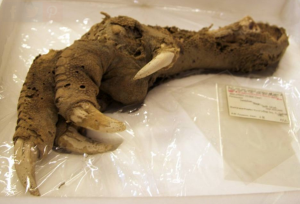
Nearly three decades ago, a team of archaeologists were carrying out an expedition inside a large cave system on Mount Owen in New Zealand when they stumbled across a frightening and unusual object. With little visibility in the dark cave, they wondered whether their eyes were deceiving them, as they could not fathom what lay before them—an enormous, dinosaur-like claw still intact with flesh and scaly skin. The claw was so well-preserved that it appeared to have come from something that had only died very recently.

The archaeological team eagerly retrieved the claw and took it for analysis. The results were astounding; the mysterious claw was found to be the 3,300-year-old mummified remains of an upland moa, a large prehistoric bird that had disappeared from existence centuries earlier.

The upland moa (Megalapteryx didinus) was a species of moa bird endemic to New Zealand. A DNA analysis published in the  Proceedings of the National Academy of Sciences  suggested that the first moa appeared around 18.5 million years ago and there were at least ten species, but they were wiped from existence “in the most rapid, human-facilitated megafauna extinction documented to date”.

See Also:

France accuses Turkey of military involvement in Armenia-Azerbaijan conflict

Turkish Islamic doctor fired from Health Ministry after promoting polygamy as an alternative to divorce

With some sub-species of moa reaching over 10 feet (3 meters) in height, the moa was once the largest species of bird on the planet. However, the upland moa, one of the smallest of the moa species, stood at no more than 4.2 feet (1.3 meters). It had feathers covering its whole body, except the beak and soles of its feet, and it had no wings or tail. As its name implies, the upland moa lived in the higher, cooler parts of the country.

>Related articles

Trump threatens tariffs against those who oppose U.S. plans for Greenland

CIA chief in Venezuela meets with Rodriguez

Ballistic missile strike hits pier in Ukraine

The Discovery of the Moa

The first discovery of the moa occurred in 1839 when John W. Harris, a flax trader and natural history enthusiast, was given an unusual fossilized bone by a member of an indigenous Māori tribe, who said he had found it in a river bank. The bone was sent to Sir Richard Owen, who was working at the Hunterian Museum at the Royal College of Surgeons in London. Owen was puzzled by the bone for four years—it did not fit with any other bone he had come across.

Read more: Ancient Origins

Ask me anything

Explore related questions

#bird#claw#discovery#frightening#Moa#Mount Owen#mystery#Paleontology#science#world
> More World

Follow en.protothema.gr on Google News and be the first to know all the news

See all the latest News from Greece and the World, the moment they happen, at en.protothema.gr

> Latest Stories

New tensions in the Middle East as Trump invites regional leaders to the Gaza Peace Council

January 17, 2026

Weather: A return to winter in the coming days – Cold and strong northerly winds – Kolydas’ post

January 17, 2026

A view of Nikolaos Stasinopoulos of Viohalco – The “enduring imprint” of Greece’s greatest industrialist

January 17, 2026

The horror of the “Tariff of the Dead”: how the Iranian regime prices the bodies of protesters

January 17, 2026

Mitsotakis on the Karystianou party: “There is a long distance between being the parent of a tragedy victim and being the leader of a political party”

January 17, 2026

Patras in carnival mode – This evening, the city’s official opening ceremony

January 17, 2026

Greenland as the first line ofdefense for the U.S. and NATO:

January 17, 2026

Changes at top universities: Oxford abolishes the term ‘doctores’ for inclusion reasons

January 17, 2026
All News

> World

New tensions in the Middle East as Trump invites regional leaders to the Gaza Peace Council

Trump’s move to form a Peace Council for Gaza brings Turkey, Egypt, Qatar and Argentina to the table, prompting unease in Israel and reshaping regional diplomacy

January 17, 2026

The horror of the “Tariff of the Dead”: how the Iranian regime prices the bodies of protesters

January 17, 2026

Greenland as the first line ofdefense for the U.S. and NATO:

January 17, 2026

Changes at top universities: Oxford abolishes the term ‘doctores’ for inclusion reasons

January 17, 2026

One dead after train–bus collision at the Port of Hamburg – see photos

January 16, 2026
Homepage
PERSONAL DATA PROTECTION POLICY COOKIES POLICY TERM OF USE
Powered by Cloudevo
Copyright © 2026 Πρώτο Θέμα