

×
GreekEnglish

×
  • Politics
  • Diaspora
  • World
  • Lifestyle
  • Travel
  • Culture
  • Sports
  • Cooking
Friday
16
Jan 2026
weather symbol
Athens 12°C
  • Home
  • Politics
  • Economy
  • World
  • Diaspora
  • Lifestyle
  • Travel
  • Culture
  • Sports
  • Mediterranean Cooking
  • Weather
Contact follow Protothema:
Powered by Cloudevo
> World

A Beautiful Crime: Soghomon Tehlirian and the birth of the concept of Genocide

Raphael Lemkin's struggle for the need for an international law punishing the wholesale annihilation of groups of people

Newsroom April 26 11:03

On the morning of March 15, 1921, at approximately 10:45 a.m., Mehmet Talaat, the former Grand Vizier of the Ottoman Empire, leaves his home with the intention of purchasing gloves. He has been living in Berlin on 4 Hardenbergstrasse for more than two years, a city he has fled to following the defeat of Turkey in the First World War. Germany has granted him asylum as compensation for having been an ally during the World War.

Not long after, Talaat passes a young man, who looks at him calmly, staring at him as though recognizing an image that has been engraved in his memory. The young man turns around and fires a shot. Talaat is killed immediately and his body remains fallen in front of a house on 27 Hardenbergstrasse. The police arrive quickly after hearing the cries of witnesses. The young man tries to walk away, however the crowd that has gathered catches up to him and begins beating him.

The incident causes a great uproar.

The murdered man had been one of the strongest rulers in the world not long ago. The killing committed in broad daylight was unheard of in its boldness. At first, Greece and Great Britain were suspected of the crime, but it was later revealed that “Turkey’s Bismarck” and “the great statesman and faithful friend” (as it was written on the funeral wreath by Germany’s Foreign Ministry) was assassinated by a young Armenian student, Soghomon Tehlirian. However, during the trial that took place on June 2-3, 1921, another even more terrible crime was revealed. Facts were disclosed that shook German society to its core.

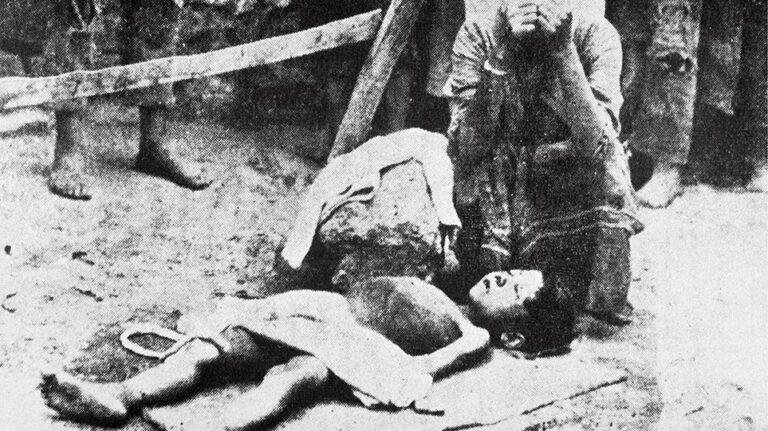
It emerged that the murder victim had been the mastermind behind the design and execution of a mass murder. Because of his diabolical plan, an entire Christian nation, the Armenians, were brutally exterminated. German society, unaware of what had transpired was horrified. Newspapers that at first were hostile toward Soghomon began to justify his actions and one of them even called Soghomon the “Armenian William Tell.” Those attending the trial would note that the testimonies of the witnesses began to put not Soghomon Tehlirian, but rather Talaat Pasha on trial.

See Also:

Alabama Governor signs law banning biological males from competing in girl’s high school sports

The Channel 4 documentary about the Greek Spitfire’s restoration (videos)

>Related articles

Trump threatens tariffs against those who oppose U.S. plans for Greenland

X is down, thousands report problems

CIA chief in Venezuela meets with Rodriguez

On June 3, 1921, the judge and jury deemed that Tehlirian was in an “unconscious state” during the commission of the crime and committed the act at a “time of mental turmoil.” Tehlirian was acquitted and walked away a free man from the courthouse. According to the experts who testified, Tehlirian’s actions were conditioned by the “manifest remembrance of a traumatic experience.” The psychological problems had surfaced because of the horrors he had witnessed when the members of his entire family were slaughtered before his very eyes, his sisters raped. Soghomon had been saved by being buried under the corpses of slaughtered Armenians. Based on the conclusion of the Medical Council and the decision by the jury, the judge in Tehlirian’s trial had declared him not guilty on the grounds of temporary insanity.

Tehlirian’s actions and the verdict were mythologized. Soghomon became the embodiment of the struggle against injustice and the horrific crime committed against an entire people. Books were written and songs composed about him. It also had a certain healing effect, not only for Soghomon, but for an entire nation. Soghomon recalled that his repeated epileptic seizures stopped after the murder of Talaat on that early morning in March 1921. At the same time, the Armenian people, engulfed by the horror of the Great Tragedy was gifted a glorious narrative, one which was possible to remember and revere. Tehlirian’s actions were considered a redemption – the main criminal behind the Great Tragedy received his worthy punishment. An entire nation that had been slaughtered and victimized was in some measure assuaged by this heroic act.

Read more: Evn Report

Ask me anything

Explore related questions

#Armenian Genocide#Armenians#Genocide#Greeks#international law#Ottoman Empire#Pontian Genocide#Raphael Lemkin#Soghomon Tehlirian#turkey#Turks#world
> More World

Follow en.protothema.gr on Google News and be the first to know all the news

See all the latest News from Greece and the World, the moment they happen, at en.protothema.gr

> Latest Stories

President of Air Traffic Controllers: Another communications blackout possible in the near future

January 16, 2026

Trump threatens tariffs against those who oppose U.S. plans for Greenland

January 16, 2026

X is down, thousands report problems

January 16, 2026

“Her father cut her hair because she asked to go to a hair salon, they never gave her money”: New testimonies about Laura

January 16, 2026

Rama persists after rant at Greek journalist and questions the link between “Greek speakers” and Plato and Aristotle

January 16, 2026

CIA chief in Venezuela meets with Rodriguez

January 16, 2026

Less alcohol and lower speeds with the new Highway Code and strict fines

January 16, 2026

The historic cafes of Athens: 12 legendary hangouts lost to time

January 16, 2026
All News

> Politics

Mitsotakis attends the inauguration of the renovated Emergency Department at Red Cross Hospital

The Prime Minister, accompanied by Adonis Georgiadis and Marios Themistokleous, was given a tour of the new Emergency Department facilities by the hospital’s governor – the second phase of the project is expected to be completed in spring 2026

January 16, 2026

Marinakis: Anestidis has no place in a meeting with Mitsotakis; The video with insults crosses the line of decency

January 16, 2026

Gerapetritis: ‘Extension of territorial waters will come, as marine parks and spatial planning’

January 16, 2026

Hydrocarbon contracts in Parliament, Greece as an energy hub with Saudi Arabia and investments in the background

January 15, 2026

Pavlos Marinakis: In principle, agreement for Mitsotakis–Farmers meeting on Monday at noon

January 15, 2026
Homepage
PERSONAL DATA PROTECTION POLICY COOKIES POLICY TERM OF USE
Powered by Cloudevo
Copyright © 2026 Πρώτο Θέμα