
×
GreekEnglish

×
  • Politics
  • Diaspora
  • World
  • Lifestyle
  • Travel
  • Culture
  • Sports
  • Cooking
Friday
16
Jan 2026
weather symbol
Athens 11°C
  • Home
  • Politics
  • Economy
  • World
  • Diaspora
  • Lifestyle
  • Travel
  • Culture
  • Sports
  • Mediterranean Cooking
  • Weather
Contact follow Protothema:
Powered by Cloudevo
> World

NASA: Hubble photographed an entire galaxy – See what Seifert NGC 3254 looks like

NGC 3254 was first spotted in March 1785 by astronomer William Herschel, about 118 million light-years from Earth

Newsroom June 22 10:02

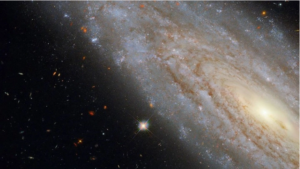
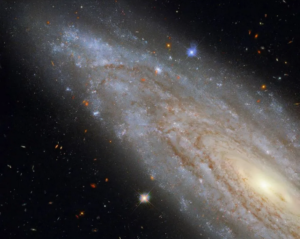
A stunning photograph of the galaxy named NGC 3254 was captured by NASA’s Hubble Space Telescope.

The Seifert Galaxies make up 10% of all galaxies and were named after the American astronomer Carl Seifert, who first studied them in the 1950s.

Seifert Galaxies are a type of galaxy, which includes an extremely bright small nucleus, which sometimes exceeds the brightness of the entire surrounding galaxy. According to NASA, these types of galaxies have “extremely active nuclei” and belong to the “active galaxies”.
>Related articles

Sick astronaut on mission – NASA considers early return of International Space Station crew

NASA published a new map of the universe; the “SPHEREx” space telescope changes the data landscape

Voyager 1 ready to make history again: in 2026 it will reach a distance of “one light-day” from Earth

The photo of NGC 3254 is a composition of infrared and visible images. On the one hand it refers to a typical spiral galaxy. However, it is actually a Seifert Galaxy, which can be best seen in light outside the visible spectrum, according to NASA.

Galaxies have oversized black holes at their center, which accumulate material which, according to NASA, emits huge amounts of radiation. Oversized black holes are defined as those that have a mass 1 or 2 billion times the typical black hole.

See Also:

Alco poll: New Democracy leads with 12.9 points

These celestial objects release gases, dust, stars and planets, which they pull and eventually destroy. NGC 3254 was first spotted in March 1785 by astronomer William Herschel, about 118 million light-years from Earth.

Ask me anything

Explore related questions

#galaxy#Hubble Space Telescope#nasa#space
> More World

Follow en.protothema.gr on Google News and be the first to know all the news

See all the latest News from Greece and the World, the moment they happen, at en.protothema.gr

> Latest Stories

Frigate Kimon: Naval cadets welcome with cheers of “Long Live the Navy”

January 16, 2026

The 10 most common surgeries in Greek public hospitals

January 16, 2026

How the high-tech scam run by Chinese nationals caught in Spata worked

January 16, 2026

Weather: Winter returns from Saturday with severe cold and snow at low altitudes

January 16, 2026

Which viruses worry infectious disease experts about the risk of a pandemic in 2026

January 16, 2026

The capabilities and firepower of Greece’s Belharra: How the frigate “Kimon” reshapes the balance in the Aegean

January 16, 2026

ENFIA discounts explained: How home insurance unlocks up to 20% off – 21 answers from AADE

January 16, 2026

Archaeologists opened a cave in Gibraltar that had been sealed for 40,000 years and made a major discovery

January 16, 2026
All News

> Greece

Frigate Kimon: Naval cadets welcome with cheers of “Long Live the Navy”

They lined up outside their school and took out their gongs to pay tribute

January 16, 2026

The 10 most common surgeries in Greek public hospitals

January 16, 2026

How the high-tech scam run by Chinese nationals caught in Spata worked

January 16, 2026

Weather: Winter returns from Saturday with severe cold and snow at low altitudes

January 16, 2026

Which viruses worry infectious disease experts about the risk of a pandemic in 2026

January 16, 2026
Homepage
PERSONAL DATA PROTECTION POLICY COOKIES POLICY TERM OF USE
Powered by Cloudevo
Copyright © 2026 Πρώτο Θέμα