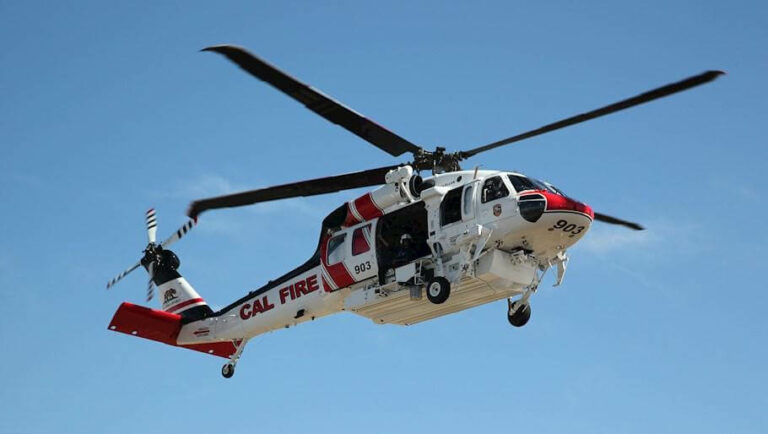
A very interesting & useful analysis by the specialized website Air Med & Rescue of certain solutions available to a serious problem firefighters face especially during wildfires: The aerial nighttime firefighting.
In the 1970s, the US halted aerial firefighting activities at night due to cost and safety concerns. However, in 2014 Governor Hickenlooper of Colorado (CoE) signed a bill that established the Colorado Center of Excellence for Advanced Technology Aerial Firefighting and mandated research on night operations. A 2018 report from the CoE stated that: “Information gathered indicates that the cost and complexity of implementing a night aerial firefighting programme in any form would be substantial, regardless of the particular path chosen by the State. Night aerial supervision and intelligence, surveillance and reconnaissance are also topics of research and will be part of any final recommendation.”
Since then, several countries – including the US and Australia – have come to the realisation that aerial firefighting at night, while presenting a different risk environment worth considering, comes with sufficient benefits to justify the practice.
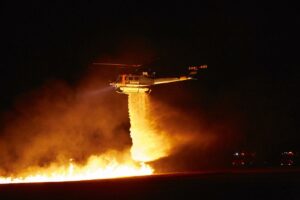
(Photo credit: Kestrel Aviation)
Indeed, AirMed&Rescue spoke to Chris Doyle, COO at Co Fire Aviation Inc. in Colorado, who said that not only is it safer to fight fires at night, it is more effective. Lower temperatures, increased humidity and reduced windspeed, for example, all result in conditions in which fires can be more easily brought under control; while fewer aircraft in the air means safer skies and less radio noise to distract crews from their vital work.
Increased risk mitigation strategies currently in use are more in-depth reconnaissance before and during the flights, the use of night vision technology, and working in pairs to ensure crew safety.
Doyle explained that, ‘working with air attack using night vision goggles (NVGs) and laser pointer capabilities, the talk on and target description is more efficient and accurate’. The need for the helicopters and fixed-wing aircraft to be equipped correctly increases though, and in addition to the obvious firefighting modifications, there needs to be NVGs and forward-looking infrared (FLIR) onboard. More on that later.
Fire in Attica: Incendiary device found in the forest of Varybombi (photos)
New trials happening
Despite the cost, global climate change has resulted in higher temperatures and more severe wildfires, prompting officials to reconsider their options for firefighting. One of the authorities in aerial firefighting is Coulson Aviation, based in Canada, but with operations around the world.
Wayne Coulson, President and CEO of the Coulson Group, told AirMed&Rescue that the company’s venture into nighttime firefighting operations has been ‘a long road’. “We started to explore night flying operations in the 1990s; flying timber off the tops of mountains, utilising twin Night Suns on the landing gear and assisted lighting the area of felled timber focusing on the perimeter with stadium lighting,” he explained. “We tried NVGs at the time, however the pilots’ depth perception was far from what the technology is today on the NVGs we are utilising. We operated this programme for five years’ winters only, as we had short days and bad weather – so to keep our utilisation up and stay efficient, this worked well.”
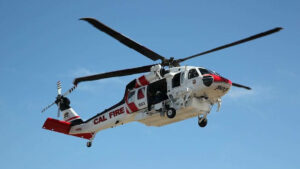
(Cal-Fire S-70i Firehawk. Photo Credit: Cal-Fire)
Then, in 2009, it all changed with the terrible events of Black Saturday in Australia, where, in the course of one day, 173 people died in wildfires. Coulson Aviation had deployed two Sikorsky S-61s to aid firefighting efforts, but as Coulson said: “There was so much work to be done that evening [that] when the aircraft parked for the day, we all felt helpless.” Upon their return to Canada, work began on figuring out how to operate safely and effectively at night. A decade and 14 different night trials later, operations could begin.
Read more: Air Med & Rescue
Ask me anything
Explore related questions