




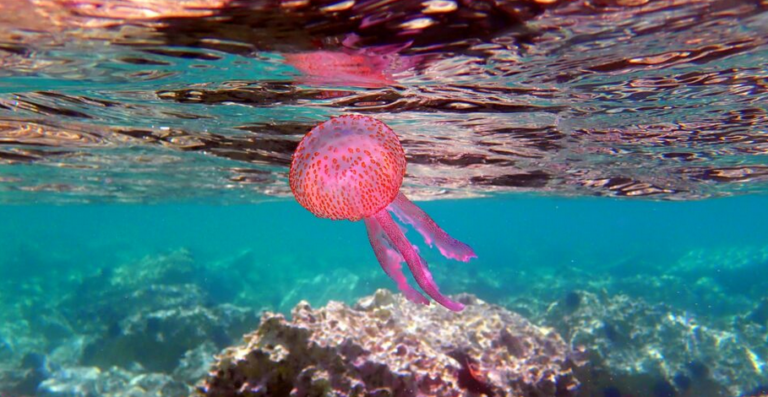
A summer with a large increase in the population of the purple jellyfish (Pelagia noctiluca) is predicted by the increased number of the presence of jellyfish in various parts of Greece.
This jellyfish has already been observed in many areas of the central and northern Aegean, but also further south, such as in Aegina.
Last weekend the problem on the island of Argosaronikos was intense, as was so on Marathon beach and the islet of Moni, with large concentrations of jellyfish.
“We are in the second year of the outbreak of the purple jellyfish (Pelagia noctiluca) in Greek waters. According to the older cycles, outbreaks of this species occurred every 10-12 years and lasted two to three years. It remains to be seen whether the specific pattern will be confirmed or there will be of longer duration”, says Mr. Epamineondas Christou, Research Director of the Institute of Oceanography of ELKETHE, to Kathimerini.
“Purple jellyfish are a pelagic species, they breed offshore and move mainly with the wind currents, reaching the beaches. Pelagia noctiluca is a species found throughout the Mediterranean. The persistence of the phenomenon in Greek waters shows that it is possible that there is a point of their reproduction in the Aegean. The appearances in the Ionian Sea come from the Adriatic and other regions”, explains Mr. Christou.
As he notes, the purple jellyfish were in the sea in the winter as well (there were reports from winter swimmers), but in the summer their reproduction easier.
“Climate change and overfishing shape an environment that facilitates the development of jellyfish,” said Mr. Christou. “Internationally, there is a growing trend in the incidence and severity of cases. The higher temperature of the sea increases their reproduction rates. On the other hand, the reduction of the populations of pelagic fish, which are their predators, creates ground for the spread of jellyfish. The same happens with the reduction of the sea turtle, which is their main predator”.
Washington Post: Kissinger says Ukraine should cede territory to Russia to end war
Jellyfish Pelagia noctiluca is one of the most undesirable species. Its sting is very painful because of the neurotoxin she has. They travel in large numbers and has a large “bell” and very long tentacles, which usually reach two meters. This poses a risk of touching a swimmer even if he is not very close to it. Her “head” is dotted. Young jellyfish are orange-brown in color, while when they become adults they acquire a bright purple color.
In case of a sting, you need to stay calm. “With seawater we clean the remnants of jellyfish tentacles that may have remained in the human body. Place ice on the spot and then a baking soda solution with sea water, in a ratio of 1:1.
“In areas where purple jellyfish have appeared, it is good to go to the beach prepared”, says Mr. Christou.
Regarding what can be done to deal with the phenomenon, the researcher of ELKETHE states that not many things can be done, as jellyfish move with the currents and we can not know where they will appear. “There is a lack of knowledge about the phenomenon. It would be important, for example, to make a study for the Corinthian, where large populations of jellyfish appeared in 2018, with a possible local source of reproduction in the great depths of the bay”. What is certain is that where stingrays appear, the beauty of swimming in the sea, the ultimate pleasure of summer, will be particularly affected.
Ask me anything
Explore related questions