

×
GreekEnglish

×
  • Politics
  • Diaspora
  • World
  • Lifestyle
  • Travel
  • Culture
  • Sports
  • Cooking
Wednesday
14
Jan 2026
weather symbol
Athens 15°C
  • Home
  • Politics
  • Economy
  • World
  • Diaspora
  • Lifestyle
  • Travel
  • Culture
  • Sports
  • Mediterranean Cooking
  • Weather
Contact follow Protothema:
Powered by Cloudevo
> World

NASA warns of 3 skyscraper-sized asteroids headed toward Earth this week

Thankfully, they'll all miss

Newsroom February 28 06:56

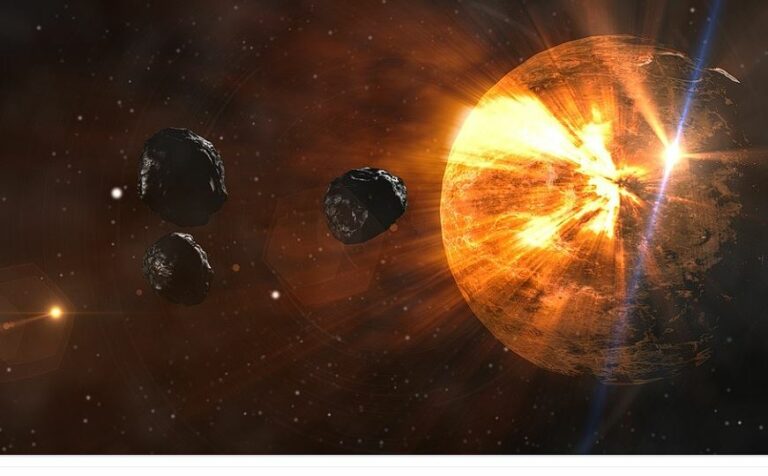
A trio of enormous asteroids, including two ‘potentially hazardous’ ones, will cross Earth’s orbit around the sun this week, according to NASA. Here’s what that means.

Our solar system is home to millions of renegade space rocks, and this week three particularly large ones will blaze past Earth. But don’t worry – the closest one will still miss our planet by a comfy 2.2 million miles (3.5 million kilometers), or about 10 times the average distance between Earth and the moon, according to NASA.

On Monday (Feb. 27), an asteroid named 2012 DK31 will sail past our planet at a distance of about 3 million miles (4.8 million km). The asteroid measures an estimated 450 feet (137 meters) across, or about as wide as a 40-story skyscraper is tall, and its orbit around the sun crosses Earth’s orbit every few years.

also read

Top Tavernas on Skopelos Island

>Related articles

Erich von Däniken, Swiss bestselling author who linked ancient civilizations to extraterrestrials, dies at 90

Sick astronaut on mission – NASA considers early return of International Space Station crew

Who were the predators on Earth before the dinosaurs

Greek Conductor to lead Byzantine Chant Ensemble in King Charles III Coronation

Although the space rock poses no imminent threat to Earth, NASA classifies it as a potentially hazardous asteroid (PHA) – meaning the rock is large enough and orbits close enough to Earth that it could cause serious damage if its trajectory changed and a collision occurred. Generally, any asteroid measuring greater than 450 feet wide and orbiting within 4.6 million miles (7.5 million km) of Earth is considered a PHA. (NASA has mapped this asteroid’s trajectory for the next 200 years, and no collisions are predicted to occur).

more at livescience.com

Ask me anything

Explore related questions

#asteroids#earth#nasa
> More World

Follow en.protothema.gr on Google News and be the first to know all the news

See all the latest News from Greece and the World, the moment they happen, at en.protothema.gr

> Latest Stories

Why Gen Z is returning to religion: what new research in the United Kingdom shows

January 14, 2026

Striking discovery about beaked whales: How sounds reveal the secrets of the most mysterious whales

January 14, 2026

Mitsotakis at a law firm for the presentation of the new digital court file

January 14, 2026

Sounion: A place of reconnection with the Ancient Greeks, the significance of the Temple of Poseidon

January 14, 2026

Meteo: Forecasts point to a warm February in Greece, with temperatures up to +1.2°C above average

January 14, 2026

Greece participates for the first time in the OECD TALIS International Survey

January 14, 2026

The head of the Hellenic Civil Aviation Authority resigned over the blackout in the Athens FIR

January 14, 2026

UBS: Greek banks in the spotlight – Piraeus Bank portfolio top pick

January 14, 2026
All News

> Travel

Kimolos wins over International Media: “A hidden gem waiting to be discovered”

Despite its small size, Kimolos is full of character and charm — and now international media are urging travelers to put this Cycladic island on their bucket list

August 28, 2025

French Vogue discovers the exotic beauty of Skopelos

August 28, 2025

Naxos tops the list of Greek kitesurfing destinations for 2025

July 9, 2025

Holidays in Psara

June 20, 2025

Santorini filled with tourists again (photos)

April 12, 2025
Homepage
PERSONAL DATA PROTECTION POLICY COOKIES POLICY TERM OF USE
Powered by Cloudevo
Copyright © 2026 Πρώτο Θέμα