
×
GreekEnglish

×
  • Politics
  • Diaspora
  • World
  • Lifestyle
  • Travel
  • Culture
  • Sports
  • Cooking
Tuesday
13
Jan 2026
weather symbol
Athens 9°C
  • Home
  • Politics
  • Economy
  • World
  • Diaspora
  • Lifestyle
  • Travel
  • Culture
  • Sports
  • Mediterranean Cooking
  • Weather
Contact follow Protothema:
Powered by Cloudevo
> Culture

“Dead nails” used in Roman grave to protect the living from restless dead

Ancient Romans feared the “restless dead” and would take magical precautions to protect themselves from these potentially dangerous beings

Newsroom March 16 05:01

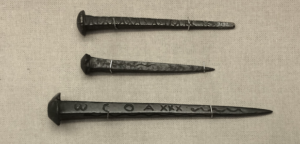
Belgian archaeologists digging at the site of the ancient Roman city of Sagalassos in southwestern Turkey recently unearthed a most unusual burial. The tomb held the cremated remains of a man who’d lived in the second century AD, and what made this burial so remarkable is that it was sealed with two dozen bricks and an additional layer of plaster. Topping everything off, more than three dozen bent nails were sprinkled around the edges of the tomb as well, presumably as magic talismans meant to keep the deceased person trapped inside.

According to the Belgian archaeologists, all these steps were taken to prevent the return of a wandering spirit, who might have the capability of rising from the grave even after cremation. In an article just published in the journal Antiquity, the study authors explained that the ancient Romans feared the “restless dead” and would take magical precautions to protect themselves from these potentially dangerous beings.

See Also:

>Related articles

Tuesday the 13th: Why everyone thinks it’s bad luck

South Korea prosecutors seek death penalty for former President Yoon Suk Yeol

Parliamentary elections set for April 12 in Hungary as Orbán appears weakened in polls

Uncontrolled Chinese rocket segment disintegrated over Texas

“The burial was closed off with not one, not two, but three different ways that can be understood as attempts to shield the living from the dead—or the other way around,” study first author  Johan Claeys , an archaeologist at Catholic University Leuven (KU Leuven) in Belgium, told Live Science .

Read more: Ancient Origins

Ask me anything

Explore related questions
#archaeology#culture#grave#roman#world
> More Culture

Follow en.protothema.gr on Google News and be the first to know all the news

See all the latest News from Greece and the World, the moment they happen, at en.protothema.gr

> Latest Stories

JPMorgan: Greece one of the most attractive markets for the Emerging Europe category

January 13, 2026

Kimon arrives at Faliro as Europe’s heavily armed frigate enters Greek waters

January 13, 2026

ELSTAT: Inflation up to 2.6% in December

January 13, 2026

Spain aims to control deepfakes created with AI

January 13, 2026

Le Pen’s party’s appeal to decide her presidential future begins

January 13, 2026

Pyrgos: man attacked his wife with a knife and then threatened to kill himself

January 13, 2026

Tuesday the 13th: Why everyone thinks it’s bad luck

January 13, 2026

Mitsotakis at meeting with farmers opens the way for meaningful dialogue on the future of the primary sector

January 13, 2026
All News

> Travel

Kimolos wins over International Media: “A hidden gem waiting to be discovered”

Despite its small size, Kimolos is full of character and charm — and now international media are urging travelers to put this Cycladic island on their bucket list

August 28, 2025

French Vogue discovers the exotic beauty of Skopelos

August 28, 2025

Naxos tops the list of Greek kitesurfing destinations for 2025

July 9, 2025

Holidays in Psara

June 20, 2025

Santorini filled with tourists again (photos)

April 12, 2025
Homepage
PERSONAL DATA PROTECTION POLICY COOKIES POLICY TERM OF USE
Powered by Cloudevo
Copyright © 2026 Πρώτο Θέμα