





Athens is attempting to reopen the “Libya file,” as the neighboring North African country remains a major “black hole” not only for regional security but also for Greek foreign policy, particularly since 2019, when Libya’s interim government signed the Turkey-Libya Memorandum of Understanding with President Erdoğan’s government.
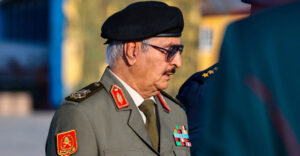
Even before it became known that the Libyan Parliament in Eastern Libya would examine the Memorandum for potential ratification, Athens had already developed a plan to re-establish communication channels with both Prime Minister Dbeibah’s government in Tripoli and the two key power players in Eastern Libya: Parliamentary Speaker Aguila Saleh and General Khalifa Haftar.
Intensive diplomatic groundwork had already taken place (Greek Ambassador N. Garilidis met last week with the Libyan Foreign Minister) to enable a visit by Greek Foreign Minister Giorgos Gerapetritis to Tripoli within June—this would be the first high-level visit since Prime Minister Kyriakos Mitsotakis and then-Foreign Minister Nikos Dendias visited the Libyan capital in April 2021.
Since then, relations froze following a tense episode during Dendias’ visit in November 2022, when he refused to meet his Libyan counterpart at Tripoli airport. He had arrived to meet Presidential Council head Mohamed al-Menfi, but canceled the meeting because the Libyan Foreign Minister had recently signed another Memorandum with Turkey, this time on the exploitation of Libya’s hydrocarbons by the Turkish company TPAO. Dendias then flew to Tobruk, where he met Aguila Saleh. Since then, ties have remained essentially frozen.
In 2019, Athens was caught off guard by the Turkey-Libya Memorandum (despite months of warning signs) and initially relied on Egypt and Eastern Libya’s authorities—who opposed the Memorandum both for legal and internal political reasons—to push back against what was seen as a brazen attempt to usurp Greece’s continental shelf. One of Greece’s main arguments for invalidating the Memorandum was that it was signed by an unelected government and never ratified by the Tobruk-based Parliament, on top of its blatant violations of the Law of the Sea.
After the 2022 incident, relations with Tripoli remained frozen, while those with Eastern Libya also lapsed.
The Visit by Haftar’s Son
On Monday, news broke that a private jet connected to the Haftar family had requested a flight permit from Benghazi. Diplomatic channels confirmed that one of General Haftar’s sons, Al-Saddiq, was coming to Athens for a private 24-hour visit, with the family vacationing and en route to another destination.
However, Al-Saddiq—one of Haftar’s six children and primarily involved in agricultural business—was one of the least prominent. Contrary to reports, there were no official meetings held in Athens during his visit.
Critical Relations
Libya’s proximity to Greece makes even minimal diplomatic engagement essential—not just to address maritime zone issues but also migration. Libya has become the primary departure point for illegal migration toward Greece, necessitating restored communication channels.
This is especially important as Libya currently needs EU support more than ever—offering Greece leverage. Additionally, Greece, as a non-permanent member of the UN Security Council, plays a vital role in decisions affecting Libya. A new UN plan for resolving Libya’s political crisis is expected to be voted on soon.
Gerapetritis’ mission, should security conditions allow the visit, will be extremely challenging, as he must balance relations between Tripoli and Tobruk.
The recent move by the Libyan Parliament to establish a committee to examine the Turkey-Libya Memorandum is seen both as a warning to Athens and a gesture toward Ankara. It also underscores the extent of Turkish influence in Libya, which has now spread beyond Tripoli’s government to the Eastern side as well.
Turkey’s Influence
Over the past two years, Turkey has methodically rebuilt ties with both Saleh and General Haftar, who have visited Ankara. Turkey has reopened its consulate in Benghazi, and in April, Haftar’s son—commander of the Libyan Liberation Army—was received with honors by Turkish Defense Minister Yaşar Güler.
In recent months, the U.S. has also begun to engage with Haftar’s side, despite his close ties with Moscow. At the same time, Egypt—previously opposed to Dbeibah’s government—has begun formal contact with Tripoli, while maintaining strong influence in Eastern Libya.
Any visit by a Greek Foreign Minister to Tripoli must be coupled with a visit to Eastern Libya to avoid the impression that Greece is taking sides in Libya’s currently dormant civil conflict. This balanced approach is now standard diplomatic protocol, with foreign officials usually visiting both Tripoli and Benghazi–Al Qubbah.
Although Libya’s internal dynamics remain unpredictable and elections to produce a legitimate, representative government are still a distant goal, Athens should seize this opportunity to establish a framework for cooperation on migration—with EU involvement—and to open a broader dialogue on bilateral relations, including the maritime zones issue.
Now… We’re Playing Catch-Up
The Libyan government’s recent demarcation of offshore blocks for licensing adhered to the median line Greece had unilaterally established under the Maniatis Law, without challenging it or claiming areas of the Greek continental shelf that the Turkey-Libya Memorandum would have allocated to Libya.
Moreover, there was no significant reaction when Greece announced licensing for two offshore blocks south of Crete—blocks aligned with Greece’s median line but overlapping areas claimed by the Turkey-Libya Memorandum on Libya’s side. Egypt also rejected Libya’s maritime delimitation proposal, which followed the Turkey-Libya Memorandum, thereby reinforcing a de facto reality that favors Greece’s position.
Libya, in letters to the UN in 2019 and 2020 responding to Athens’ objections to the Memorandum, had expressed interest in negotiating a maritime boundary agreement with Greece. Athens should not overlook this public commitment made by Tripoli at the UN—even if the Dbeibah government is interim and contested, Greece should seek a renewed commitment to start preliminary talks on delimitation.
If these talks fail, Greece should aim to refer the dispute to the International Court of Justice in The Hague, where Libya has previously brought similar cases (against Malta and Tunisia).
For all these initiatives, if conditions permit, it’s essential that Athens also coordinate with Eastern Libya. This will prevent the perception that Greece is siding with Dbeibah in the internal conflict and clarify that Greece aims to engage institutionally with the entire Libyan state.
Otherwise, there is a risk that Haftar and Saleh—who have already rekindled their ties with Ankara—may attempt to create faits accomplis.
Eastern Libya is also critical for controlling migration, as many “ghost ships” carrying hundreds of migrants from Central Africa and Egypt to Crete set sail from the regions it controls.
Ask me anything
Explore related questions