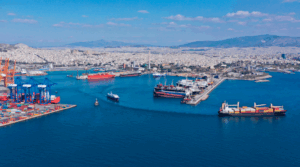
The United States government has launched a broad strategic initiative aimed at curbing China’s influence in globally significant ports. Among the targets is the Port of Piraeus, which has been leased to COSCO.
According to Reuters, this initiative stems from Washington’s fears that China, through state-owned or state-linked companies, has gained substantial control over critical port infrastructure that could be used in the event of a geopolitical crisis, for espionage, or to disrupt supply chains.
As part of this effort, the U.S. is considering various options: from strengthening shipbuilding and commercial shipping under American control, to promoting private investment in ports where China holds shares, as well as imposing customs or other regulatory measures.
Regarding Piraeus in particular:
COSCO (China Ocean Shipping Company), one of China’s largest port and shipping companies, holds 67% of the share capital of the Piraeus Port Authority (OLP).
According to Reuters’ sources, the U.S. strategy specifically highlights Piraeus as an example of a port where China’s influence expansion is already in progress.
In January 2025, the U.S. Department of Defense added COSCO to a list of companies considered to have ties with the Chinese military.
Inclusion on this list does not automatically entail financial sanctions but aims to discourage U.S. businesses from engaging in transactions with COSCO.
The Greek government, as well as port stakeholders, are examining the potential implications of this move – although so far, no operational disruption has been reported at the Port of Piraeus.
The U.S. is considering supporting the participation of private Western companies or investors to acquire stakes in ports where China is involved.
There are also discussions about extending oversight to shipyards, records of ships registered under the U.S. flag or controlled by U.S. authorities, and more broadly strengthening the “shipping lines” that the country could use militarily or economically in times of crisis.
COSCO has denied that its subsidiaries on the list are linked to the Chinese military and maintains that its operations continue as normal.
The Greek side states that it has not been officially informed of any plans to alter the ownership or management of Piraeus due to U.S. concerns.
According to Reuters, Washington has launched its most significant effort to bolster its maritime and port influence since the 1970s, with the aim of limiting China’s growing control over strategic ports around the world.
The U.S. government is concerned that Chinese presence in critical maritime infrastructure—from Europe and the Mediterranean to Panama and the U.S. West Coast—could be leveraged for espionage, military advantage, or the disruption of supply chains in times of crisis. In this context, options under consideration include bolstering Western investors to acquire Chinese stakes in ports, supporting U.S. commercial shipping, and expanding cooperation with allies to reduce reliance on Chinese networks and safeguard U.S. national security.
U.S. authorities believe that the American commercial fleet lacks sufficient infrastructure to support military operations in the event of war, while dependence on foreign maritime infrastructure is considered excessive. China maintains that its investments are conducted in accordance with international law and condemns unilateral sanctions or economic pressure, which it says undermine the rights and interests of other countries. At the same time, experts such as Stuart Poole-Robb, founder of the KCS Group, emphasize that U.S. concerns focus on the risk that these infrastructures could be exploited for espionage, military advantage, or supply chain disruption.
Washington’s attention is now focused on strategically important ports, where the balance between commercial investments and national security has become a critical issue for international policy and trade flows.
Ask me anything
Explore related questions