




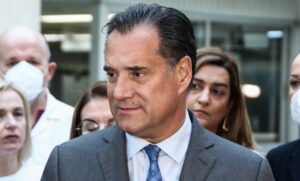
Health Minister Adonis Georgiadis testified today in the trial of the two protected Novartis witnesses. “The only year Novartis had losses in Greece was during my term in 2014. Not only was there no favoritism toward the company, but it was actually treated worse than others,” Georgiadis said, attributing “intent” to Filistor Destampasidis and Maria Marangeli—known under the code names “Maximos Sarafis” and “Aikaterini Kelesi”—for what they testified against him as protected witnesses.
Among other statements, Georgiadis said:
“I reaffirm my initial testimony. In 2013–2014 I was Minister of Health, and during extremely difficult circumstances I undertook the responsibility of controlling the financial data of pharmaceutical spending. My tenure is linked to the lowest pharmaceutical spending in history. When, years later, the so-called Novartis case began to circulate, I told my wife: ‘It’s great—there is no way they can accuse me.’ To be fair, I must say the adjustment began under Salmas and Loverdos. Nevertheless, information began to surface about depositions against me from protected witnesses. You know the rest.”
Continuing, he told the court:
“Mr. Destampasidis and Ms. Marangeli were also witnesses in the United States. This is crucial. This is illegal, and this is where the whole matter lies. Why? Because they had personal financial gain, and no prosecutor in Greece had the right to grant them ‘public-interest witness’ status once they had already received money.”
“After Vourliotis’ investigation, there is no doubt they testified in the U.S. In their U.S. depositions, they said nothing about bribing political figures in Greece. Isn’t it contradictory that they didn’t ‘remember’ in the U.S. that I supposedly took €2 million, yet told this to Touloupaki? If they had said the same things in both Greece and the U.S., I would say this was their belief—but that is not the case. They acted with intent. Their intent lies in the fact that in the U.S. they spoke about doctors bribed by Novartis, while here they suddenly spoke about politicians. Touloupaki illegally granted them public-interest witness status because they thought this would protect them from punishment. Nothing they testified against me has been proven. I am sorry none of this came out at first instance. Let me tell you—at the first trial they claimed they were not U.S. witnesses. Three months ago Marangeli told you she had no money, and now it has been proven she received $24 million in the U.S. The lie went to another level.”
Regarding Novartis, Georgiadis repeated that the only year the company posted losses in Greece was during his tenure. “If they managed to pay me even though I caused them losses, what can I say? I would have to be an emperor, not a minister,” he said.
Judge: “The issue is what losses Novartis had compared to other pharmaceutical companies.”
Georgiadis: “We had a memorandum obligation to repay debts to pharmaceutical companies. What did Marangeli claim? That I supposedly took €2 million so Novartis would be paid first. They were not privileged. In fact, they were disadvantaged. If Touloupaki had simply spread out the EOPYY payment lists, she would have seen this claim was false.”
Georgiadis was also questioned about his relationship with the former powerful head of Novartis Greece, Konstantinos Frouzis.
“He was not my friend; he was an institutional counterpart in the Ministry’s dialogue. Yes, there were messages and calls—every day pharmaceutical companies called about outstanding payments. He was the president of SFEE. Our conversations were never about Novartis-specific issues but always about payments. The companies knew Greece would not receive funds from its partners unless we settled these debts. My greatest anger toward Touloupaki is that she failed to see the absurdity of the whole story.”
Regarding the infamous Harvard Project, Georgiadis called it a “huge stupidity.” He stated:
“As Minister of Health I receive invitations to deliver greetings at conferences. One day I attended an EKPA (National and Kapodistrian University of Athens) event about a planned collaboration with Harvard on clinical studies. Seriously? They accused us over such nonsense?”
Judge: “What is the role of the Minister in drug pricing?”
Georgiadis: “The Minister’s role is institutional—to set the framework. We take the average price of drugs in the 28 EU countries and must set it to the average of the three cheapest. That’s how we achieved rapid price reductions. Pricing is done by EOF, not the Minister. No minister has the right to participate directly in pricing.”
Elsewhere in his testimony, he focused on defendant Filistor Destampasidis:
“He claimed it is widely known that through my publishing company I laundered money. I inherited the publishing company from my parents. What does that mean—that I supposedly had it for money laundering 22 years before Samaras made me a minister?” Georgiadis said, adding:
“They opened the bank accounts of my entire family. They searched everything. And after all that, they found nothing. That’s why the case was archived.”
Prosecutor: “Why would the defendants testify what they testified against you?”
Georgiadis: “Mr. Polakis said at the time that ‘we caught them stealing and they sang.’ I believe the defendants struck an agreement and played their part in a scheme for their own benefit. In the U.S., they spoke about a Novartis network that bribed doctors—which is true. But when they came here, they suddenly remembered rolling suitcases. Marangeli claimed here she had no money, while in fact she has €24 million in Switzerland. Only three months have passed since she said she was destitute. It’s frustrating that you are an appeals court and cannot impose higher sentences.”
He was then questioned by the defense about how he knows what the defendants testified in the U.S.:
Defense: “How do you know what they testified in the U.S.?”
Georgiadis: “I submitted a request via letter to the FBI. There is nothing concerning political figures.”
Defense: “It’s one thing for there to be no reference and another for there to be no investigation—the U.S. might simply have chosen not to investigate. Do you have copies?”
Georgiadis: “No.”
The defense then suggested that the U.S. ambassador to Greece, Kimberly Guilfoyle, could be called to testify regarding the American investigation. Lawyers for the prosecution noted that the relevant documents already exist among the case files.
Ask me anything
Explore related questions