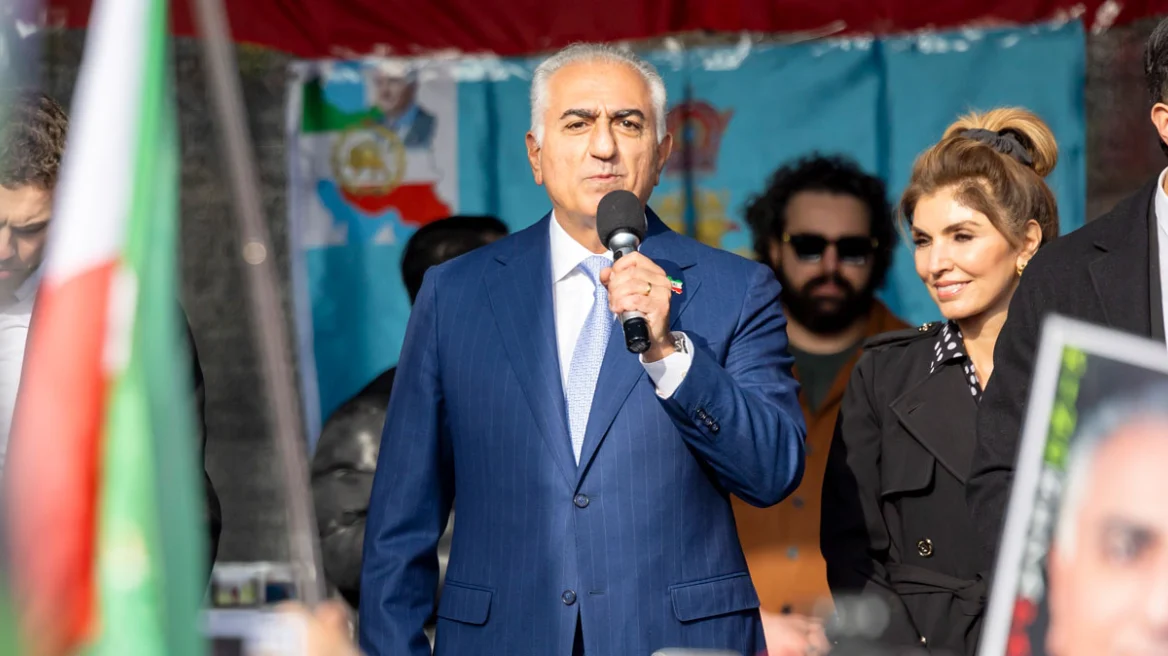
“I am preparing to return”: The exiled son of the Shah of Iran wants to sit on the Peacock Throne, and the protests are his opportunity — he calls for an uprising
In a message to the nation today, Reza Pahlavi calls for a general strike and the occupation of cities – As the theocratic regime of Tehran is shaken to its core, hopes of his “restoration” appear realistic after a long time
Giorgos Karagiannis
The son and heir of the Shah of Iran,Mohammad Reza Pahlavi, was just 17 years old when the Revolutionary Guards overthrew his father and sent him into exile in 1979. The dream of sitting on the legendary Peacock Throne, or Sun Throne (part of which survives today in the vault of the Central Bank of Iran), seemed insane until now.
Today, at 65 years of age, as the theocratic regime of Tehran is shaken to its foundations, watching enraged protesters even burn the tomb of Khomeini, the leader and inspiration of the Revolution, his hopes have, for the first time, a solid basis. “I am ready to return,” he declares, calling on the people to escalate their protests by paralyzing the state.
هممیهنان عزیزم،
شما با شجاعت و ایستادگی خود، تحسین جهانیان را برانگیختهاید. حضور دگرباره و پرشکوهتان در خیابانهای سراسر ایران در شامگاه جمعه، پاسخی دندانشکن به تهدیدهای رهبر خائن و جنایتکار جمهوری اسلامی بود. یقین دارم که او این تصاویر را از مخفیگاهش دیده و از وحشت لرزیده… pic.twitter.com/MaQDiwkXRL
The demonstrations that began in Tehran due to poor economic conditions have spread to at least 100 cities and all 31 provinces, with dozens (reportedly 65, although a doctor who spoke to TIME magazine refers to at least 217) dead, according to the NGO Iran Human Rights, based in Norway. Those arrested by the regime are approaching 3,000. Cities have come under the full control of protesters, while mosques and government buildings are being set ablaze. Iran has descended into chaos, and Khamenei threatens that the Revolutionary Guards will drown in blood the uprising underway, which he attributes to “the hand of the United States.”
Below his address on X, videos created with Artificial Intelligence show Pahlavi stepping off an airplane at an airport flooded with Iranian flags held by a massive crowd. Not by coincidence, Ali Khamenei removed the word “Iran” and anything related to his status, as Elon Musk’s social media platform “took down” the flag of the Islamic Republic and replaced it with the historic — and banned in Iran — flag bearing the lion and the sun. Protesters in burning cities, especially in Tehran, have taken to the streets waving these flags.
As Iranian women defiantly light cigarettes and throw off the headscarf from their hair — an act punishable by death for such “revolutionary actions” — protests have erupted in Tehran and in cities across every corner of the country. In the east, Mashhad; in the north, Tabriz; in central Iran, Qom. With the internet cut off in Iran to prevent protesters from contacting the “outside world,” and Musk helping demonstrators by providing access via Starlink, Nobel Peace Prize laureate (2003) and self-exiled Iranian lawyer Shirin Ebadi expresses fears that the regime will try to drown the protests in blood, arguing that the internet shutdown represents a “strategic choice” rather than a “technical problem.”
And indeed. As dozens of cities burn and some have come under full control of protesters, it is estimated that the dead exceed 62. Iranians are waiting for Trump to fulfill the promise he made to intervene if protesters are killed, and in Israel public opinion is pressuring Netanyahu to do what Trump did with Nicolás Maduro — arresting or executing Khamenei. Khamenei, of course, is now in hiding and has placed the country’s missile arsenal on the highest state of alert. Is the time approaching?
“Occupy the cities”
Analysts say this is the most critical and most dangerous moment the mullahs’ regime has ever faced. Pahlavi knows this is his opportunity. That is why, after calling for demonstrations, he calls Iranians to a general strike. In his address this morning (broadcast via the X platform), the heir to the Iranian throne states:
“My dear compatriots. You have inspired the admiration of the world with your courage and unwavering stance. Your once again glorious presence on the streets of Iran on Friday night was a terrifying response to the threats of the traitorous and criminal leader of the Islamic Republic. I am certain he saw these images from his hiding place and trembled with fear.
Iranian protesters have set fire to the Al-Rasool Mosque in Tehran.
Now, with your decisive response to the first call, I am certain that by making our presence on the streets more targeted and, at the same time, cutting off funding channels, we will bring the Islamic Republic and its worn-out and fragile repression apparatus completely to its knees.
In this context, I call on workers and employees in key sectors of the economy, especially transportation, as well as oil, natural gas, and energy, to begin a nationwide strike.
I also call on all of you to take to the streets today and tomorrow, Saturday and Sunday, January 10 and 11, this time starting at 6 p.m., with flags, images, and national symbols, and to occupy public spaces. Our goal is no longer simply to take to the streets. Our goal is to prepare for the conquest and defense of city centers.
To achieve this goal, move as many routes as possible toward central points of the cities and connect diverse populations. At the same time, prepare now to remain in the streets and stock up on the appropriate supplies.
To the youth of the Eternal Guard of Iran and to all armed forces and security forces who have joined the National Cooperation Platform, I say: slow down and further disrupt the repression machine so that, on the promised day, we can completely disable it.
I am also preparing to return to my homeland to be with you, the great Nation of Iran, when our national revolution prevails. I believe that day is very near. Be strong, Iran!”
These are not merely words. The eldest son of the deposed Shah sees in videos protesters chanting “Javid Shah” (Long live the Shah), “Shah Reza, may God bless you,” and “this is the final battle, Pahlavi will return.” The crown — or rather the throne of a country with enormous oil reserves — seems to be waiting for Pahlavi.
That throne Reza Pahlavi dreams of sitting on is the legendary Peacock Throne, or Sun Throne (part of which survives today in the vault of the Central Bank of Iran), like his father before him. One “detail” is that the Peacock Throne was built in the 17th century by Shah Jahan and is considered to have cost twice as much as the Taj Mahal (!) as it contained, among other things, 1,150 kilograms of gold, 230 precious stones — including some of the most famous diamonds and rubies — had two golden peacock tails, and was designed like the Throne of Solomon.
Are these summer-night dreams for Reza Pahlavi? Based in the United States, the deposed Shah — or heir Shah — declares at every opportunity that he is ready to return to take power and reminds people, with “then and now” photos, how “Western,” carefree, and free Iranians lived when his father ruled.
When the “Woman, Life, Freedom” protests erupted in Iran in 2022 after the murder of 22-year-old Mahsa Amini by the morality police for not covering her hair, Pahlavi, through his very active X account, began reminding Iranians of his presence. Today, more and more believe conditions are riper for his return, with a simultaneous collapse of the regime — and he himself certainly shares that belief.
In a dramatic, recorded message on X, Pahlavi calls on Iranians not to give their lives for “a regime that is on an irreversible path of collapse” and to rise up to “reclaim Iran.” He stresses that “Khamenei is hiding like a frightened mouse” and promises that “the future is bright and together we will pass this turning point in our history.” He justifies his absence by saying that “for years I tried to avoid throwing Iran into the flames of war that the regime has been throwing it into for 46 years.” He closes his message wishing that “soon we will be together,” saying, “Long live Iran, long live the Iranian nation.”
With the Shah’s heir essentially unknown to most of the generations that currently “hold the knife and the melon” in Iran, it remains an open question whether he will ever actually manage to return to the country, even if the regime falls. The truth is that Pahlavi has managed to build a strong support network among Iranians of the Diaspora, who call for a non-violent transition to a new order through a referendum to elect a new government.
BREAKING:
Tehran is on fire
Video shows several residential buildings burning in the Narmak district in northeast Tehran, with sounds of gunfire and people screaming in the background. pic.twitter.com/nhv9DecfHs
This narrative, along with the nostalgia with which many Iranians view photos from the 1970s showing female students in swimsuits on beaches or miniskirts in central Tehran, is a powerful weapon in Pahlavi’s hands. On the other hand, there are also those who remember — and remind others — of the reasons the Pahlavis were expelled 46 years ago, since most Iranians are not old enough to remember or have experienced life before the revolution. They recall the sell-off of natural resources by the Shah, as well as his legendary parties with Western guests, while Iranians’ living standards collapsed and corruption flourished.
Yes, Reza Pahlavi, who was appointed crown prince by his father back in 1967, leads the National Council of Iran, an exiled resistance organization. Yes, for many years he has criticized the Islamic Republic and has presented ideas suggesting he could modernize the economy, protect civil liberties, and put Iran back on the international community’s radar. However, no one can be sure that Iranians actually want him. What can be certain is that no one can label him a “traitor” or a foreigner.
Pahlavi studied political science at the University of Southern California and trained as a pilot in the U.S. Air Force. When the Iran–Iraq war broke out, Pahlavi, as a trained and certified fighter pilot, offered to return and serve his homeland by fighting in the cockpit of an Iranian aircraft. The mullahs forbade it. Since then, he has written a series of books and continues to call for regime change in Iran.
The anti-government protests that yesterday marked two weeks in Iran were the culmination of demonstrations that began in Tehran’s Grand Bazaar over economic problems but quickly took on an anti-regime character. Pahlavi, who lives in the U.S., attempted to emerge as the de facto leader.
Support for the overthrown monarchy is taboo in Iran, constitutes a criminal offense, and is a sentiment long rejected by a society that organized a popular uprising to overthrow the Shah’s dictatorship.
It is unclear what is driving the renewed enthusiasm for the royal family and its honorary leader in exile, analysts say. Do Iranians truly support the restoration of the monarchy, or are they simply tired of their oppressive theocracy?
“Reza Pahlavi has undoubtedly increased his influence and has become a frontrunner of the Iranian opposition,” said Arash Azizi, academic and author of What Iranians Want. “However, he also faces many problems. He is a divisive figure, not a unifying one.”
For decades, the Islamic Republic has neutralized domestic opposition by imprisoning critics, including former presidents. Supreme Leader Ayatollah Ali Khamenei, the highest authority in Iran, restricts the powers of elected officials and views his mandate as that of guardian of the regime, suppressing challenges to his authority.
This strengthened the external opposition, born of Iran’s large diaspora, bringing figures like Pahlavi out of relative obscurity. Pahlavi first came to prominence in 2020, when Iran accidentally shot down a commercial flight that had departed Tehran for Ukraine. The incident mobilized the external opposition, pushing it to coalesce into a council with Pahlavi as a prominent member.
Disagreements among various Iranian dissidents led to the council’s premature dissolution. Nevertheless, Pahlavi remained the most recognizable opposition figure. Israeli Prime Minister Benjamin Netanyahu has been his most prominent supporter — an alliance that has polarized Iranians (Israeli strikes hit parts of Iran during a 12-day war between the two countries last June).
Revolution against the…Revolutionary Guards
Now, massive, angry crowds of Iranians have taken to the streets of the capital, Tehran, and many other cities, demanding the end of the Islamic Republic and, in many places, the restoration of the monarchy.
Young and old, rich and poor, Iranians from across the country and all social strata are now expressing their rage against the clerical establishment that has ruled them for nearly half a century. A young woman in Tehran tells the BBC she is protesting because her dreams were “stolen” and wants the regime to know that “we still have a voice to shout and a fist to punch them in the face.” Another spoke of the despair and hopelessness driving the protests. “We live in a state of uncertainty,” she said. “I feel like I am suspended in the air with no wings to emigrate and no hope to pursue my goals here. Life here has become unbearable.”
Day by day, since late December, protests in Iran have spread and gained momentum, fueled by deep economic and political frustration. They are spreading like a terrifying wildfire across Iran, with cities burning (literally) until they fall into protesters’ hands. Tehran, Qom, Tabriz, Rasht, Kermanshah, Mashhad, Yazd, Kerman, Zahedan, Bandar Abbas, Abadan, Shiraz are just some of the dozens of cities that have been given over to the flames.
The regime is now being described by many analysts as “zombie-like.” For the first time, the possibility of Khamenei’s overthrow is being discussed in the country. Analysts explain that if this happens, it will not be like 1979, when the Shah fell, because today Iran is different, with many distinct centers of power.
Above all, Iran’s Supreme Leader, Ayatollah Ali Khamenei, does not appear willing to leave “peacefully,” as the Shah did. In a message, he described anti-government protesters as “troublemakers” trying “to please the President of the United States.”
Iran also sent a letter to the United Nations Security Council accusing the U.S. of turning the protests into what it called “violent subversive actions and widespread vandalism” in Iran. Trump, for his part, said Iran is “in great trouble.”
Khamenei remained defiant in a televised address on Friday. “Let everyone know that the Islamic Republic came to power with the blood of hundreds of thousands of honorable people and will not retreat before those who deny this,” said the 86-year-old. Later, in remarks delivered at a rally of supporters and broadcast on state television, Khamenei doubled down, saying Iran “will not hesitate to confront the destructive elements.”
AADE: Six new digital “weapons” against tax evasion in 2026
Target: 72,800 audits and additional revenues of €2.5 billion with Artificial Intelligence, real-time monitoring, and preventive risk analysis
Opening access to a market of 300 million consumers for Greek products through the EU–Mercosur agreement: Benefits for olive oil, cheeses, kiwifruit, peaches and bakery products
JP Morgan: STOXX will upgrade Greece this year – Which stocks will see significant inflows
How Greek producers and the 21 Greek PDO products will be protected under the Mercosur Agreement
“Turbulence, yes; problems, no” is what the Mercosur agreement is expected to bring for Greece