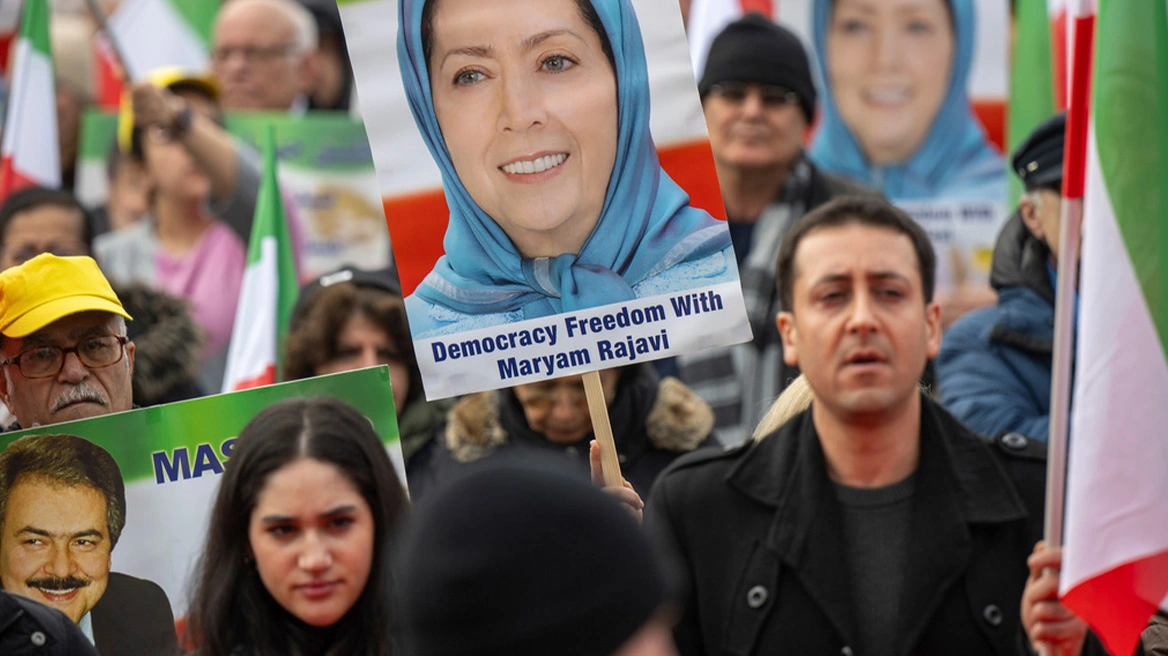
Maryam Rajavi belongs to the generation that initially believed the Iranian Revolution of 1979 would lead to a pluralistic post-monarchical system. That bet was quickly lost. The clash between the new theocratic regime and the Islamist-leftist organizations was violent and relentless.
She joined early on the Mujahedin-e Khalq (MEK) movement, which soon became a target of the Khomeini regime. Mass executions, imprisonments, and persecutions forced the MEK leadership to leave the country. Rajavi followed the path of exile—first to France, then to Iraq, and back to Europe after 2003.
The network she represents
Rajavi does not act alone. She represents the National Council of Resistance of Iran (NCRI), an umbrella political organization with a clear hierarchy, structure, and strategic planning. The MEK forms its backbone.
It is a closed, disciplined, and highly organized network, with decades of experience in operating underground, surviving persecution, and exerting international political pressure. This very characteristic—organizational cohesion—is what distinguishes it from other exiled opposition groups.
Who finances her
Here the landscape becomes carefully opaque. Rajavi and the NCRI claim they are financed by the Iranian diaspora, through donations and support campaigns. There is no evidence of direct state funding from Western governments.
However, the presence of former high-ranking Western officials at her events—especially from the United States and Europe—indicates political tolerance and indirect support. For the West, Rajavi functions as an institutionally “useful” opposition: organized, predictable, and unequivocally hostile toward Tehran.
Why she appears more “ready” than the royal family
The descendants of the last Shah, most prominently Reza Pahlavi, possess name recognition but lack machinery. They express nostalgia, not political infrastructure. They have no party, no network, no disciplined base. Rajavi, by contrast, appears with a transition plan, a ten-year political program, a clear institutional proposal, and a ready administrative core. She does not promise a return to the past, but a break from it.
The risk of the “ready-made solution”
The problem remains social legitimacy within Iran. The MEK does not enjoy broad popular acceptance and carries historical traumas, especially from the period of its cooperation with Iraq during the war of the 1980s. However, in a scenario of abrupt regime collapse, politics will not be decided solely by popularity but by readiness.
Maryam Rajavi is not the most beloved option for Iran. But she is the most organized. In a system that may break suddenly, this factor could prove decisive. If a power vacuum emerges, she will not be searching for it. She will already be there.
Ask me anything
Explore related questions