





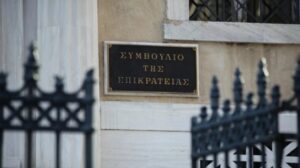
The Council of State, in two decisions, has recognized that the Ministry of Education failed for two years to take the necessary legal steps to introduce an alternative subject in high schools for students exempted from the religious education course.
Specifically, the enlarged composition of the Third Chamber of the Council of State, with Vice-President Dimitris Makris presiding and State Counsel Odysseus Spahis serving as rapporteur, ruled that the Ministry of Education delayed for two years in introducing the alternative course of ethics (“Curriculum of the Course of Ethics for High School”) for students exempt from the religious education course.
The cases were brought by two parents who requested that the Council of State annul the Ministry of Education’s failure “to establish an equivalent course to the Religious Studies course, of related content, for high school students exempted from the compulsory religious studies course,” following earlier decisions of the Plenary Session of the Supreme Court of Cassation on the matter.
The State advisers ruled that the Ministry of Education had a legal obligation to organize the alternative course by the end of the 2022–2023 school year, which it failed to implement.
It was further ruled that the Ministry of Education, despite its binding authority, had not issued, for the 2025–2026 school year, “all the prescribed ministerial decisions necessary to fulfill its obligation for the uninterrupted implementation of the teaching of a course alternative to the religious education course for high school students who wish to take it, and therefore failed to take due legal action.”
The State Counsel emphasized:
“In accordance with Articles 16(2) and 13(1)–(2) of the Constitution, Articles 9 and 14 of the ECHR, Article 2 of the First Additional Protocol to the ECHR, and consistent with the decisions of the Plenary Session of the Council of State (1749–1750/2019 and 1478–1480/2022) and subsequent decisions of the Court (1175/2025, 1836/2025), the Ministry of Education was obliged to establish an alternative course to the religious education course. This obligation arises directly from the Constitution, the ECHR, and the aforementioned Council of State decisions.”
Following this, the administration was required to complete all actions prescribed by law to ensure the teaching of an alternative subject to the religious education course for students who wish to attend it.
Among these obligations is the issuance of the necessary ministerial decisions. Failure to regulate these issues through the issuance of the required decisions constitutes a failure to take due legal action.
Ask me anything
Explore related questions