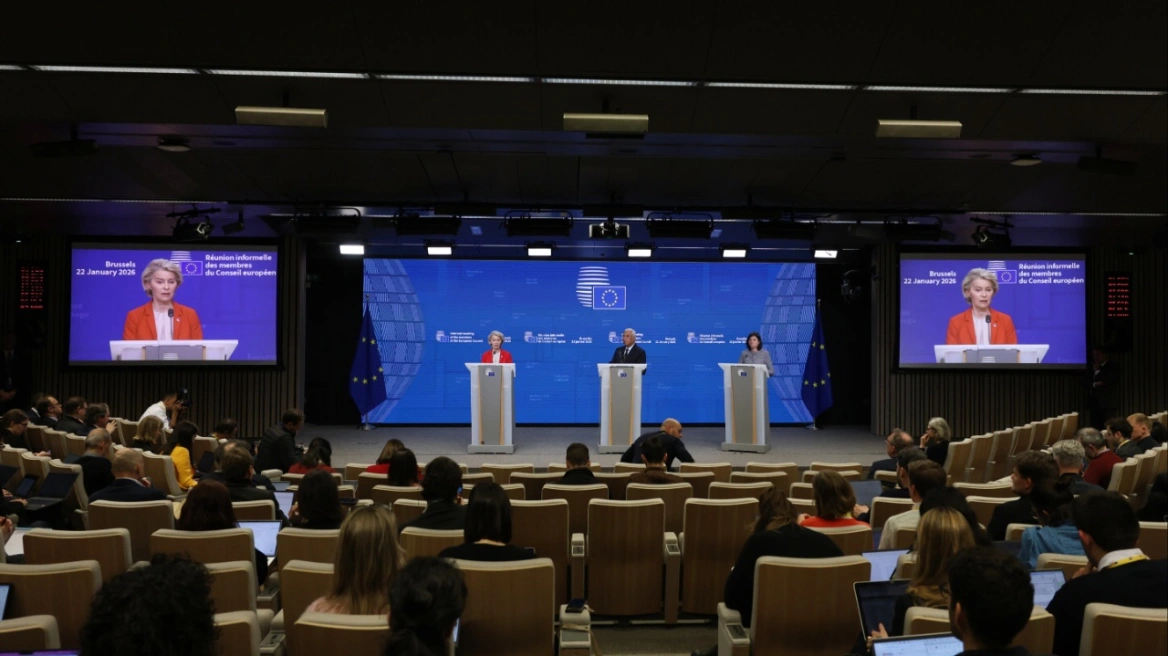
With attention focused on the stance of the United States and the impact on transatlantic relations, the emergency summit of European leaders in Brussels concluded with the EU appearing cautiously optimistic after Donald Trump’s retreat from threats over tariffs and Greenland, while remaining determined to stay on alert.
Cautious relief after Trump’s retreat
Although US President Donald Trump stepped back from his most aggressive statements regarding the imposition of tariffs and the “takeover” of Greenland, this development was not enough to fully dispel concerns in European capitals.
“We started the week with escalation, threats of invasion and tariffs, and we have returned to a clearly more acceptable situation,” said French President Emmanuel Macron, adding that Europe “remains vigilant.”
Von der Leyen’s four messages
European Commission President Ursula von der Leyen outlined the main conclusions of the summit:
- Unquestionable solidarity with Denmark and Greenland
- Support for member states threatened by US tariffs
- Dialogue with the US in a “firm but non-escalatory” manner
- Readiness for trade countermeasures if Washington changes course again
Special emphasis was also placed on security in the Arctic and continued support for Ukraine.
Costa: EU has serious doubts about Trump’s “peace council”
The European Union has “serious doubts” about the “Peace Council” announced by US President Donald Trump, particularly regarding its compatibility with the United Nations, stressed European Council President António Costa in the early hours of the morning.
“We have serious doubts regarding a number of elements of the Peace Council’s charter, its scope of action, its governance, and its compatibility with the United Nations Charter,” Costa said after the conclusion of the emergency summit of the 27 in Brussels.
The American president presented his new “Peace Council” on Thursday in Davos, with around twenty national leaders present who joined the body under Trump’s personal control.
EU welcomes Trump’s decision not to impose tariffs
The European Union welcomed Donald Trump’s decision not to proceed with the imposition of additional tariffs as he had threatened and wants to “move forward” with implementing its trade agreement with the US, António Costa assured today.
“The announcement that there will be no new American customs tariffs on Europe is positive. The imposition of new tariffs would be incompatible with the EU–US trade agreement,” Costa told the press.
“We should now focus on implementing the agreement,” the Portuguese official added.
The EU will continue to “defend its interests” against “any form of coercion,” the president of the European Council emphasized.
“It has the strength and the means” and “will do whatever is necessary,” Costa insisted.
EU–US trade agreement “thaws”
According to Politico, the leaders of the 27 are seeking to restore a cooperative climate with Washington, using Trump’s retreat as an opportunity to return to “normality.”
In practice, this means that the ratification of the EU–US trade agreement is being taken “out of the freezer,” after it had been frozen by the European Parliament following threats over tariffs and Greenland.
“There is an agreement between the US and the EU on trade. We are reliable partners and these agreements must be respected,” said an EU official directly involved in the talks, speaking anonymously.
The agreement had been signed in July by Donald Trump and Ursula von der Leyen, but the intense rhetoric of recent weeks had blocked its ratification.
Metsola: “We can move forward”
Addressing EU leaders, European Parliament President Roberta Metsola appeared positive about advancing the agreement following Trump’s de-escalation.
“We are pleased that, for now, escalation is off the table. This means we can continue our internal discussions on the EU–US trade agreement,” she said, according to Reuters.
Earlier, the EPP’s chief negotiator, Željana Zovko, said that Parliament “hopes” to decide as early as Monday to restart the ratification process.
Pressure from Washington for swift approval
At the same time, the US ambassador to the EU, Andrew Puzder, pushed for immediate approval of the agreement, accusing those in Brussels who claim Trump is undermining the transatlantic relationship.
“The real instability comes from the EU’s own failure to act on the historic trade agreement,” he argued, stressing that its aim was “to restore predictability and growth.”
Aid to Ukraine and NATO on Greenland
The EU announced it will send 447 generators to Ukraine to meet critical needs amid winter conditions and Russian attacks on energy infrastructure.
Finally, Hungarian Prime Minister Viktor Orbán described the Greenland issue as a NATO matter rather than an EU one, noting that the Alliance is the appropriate framework for managing the crisis.
Ask me anything
Explore related questions