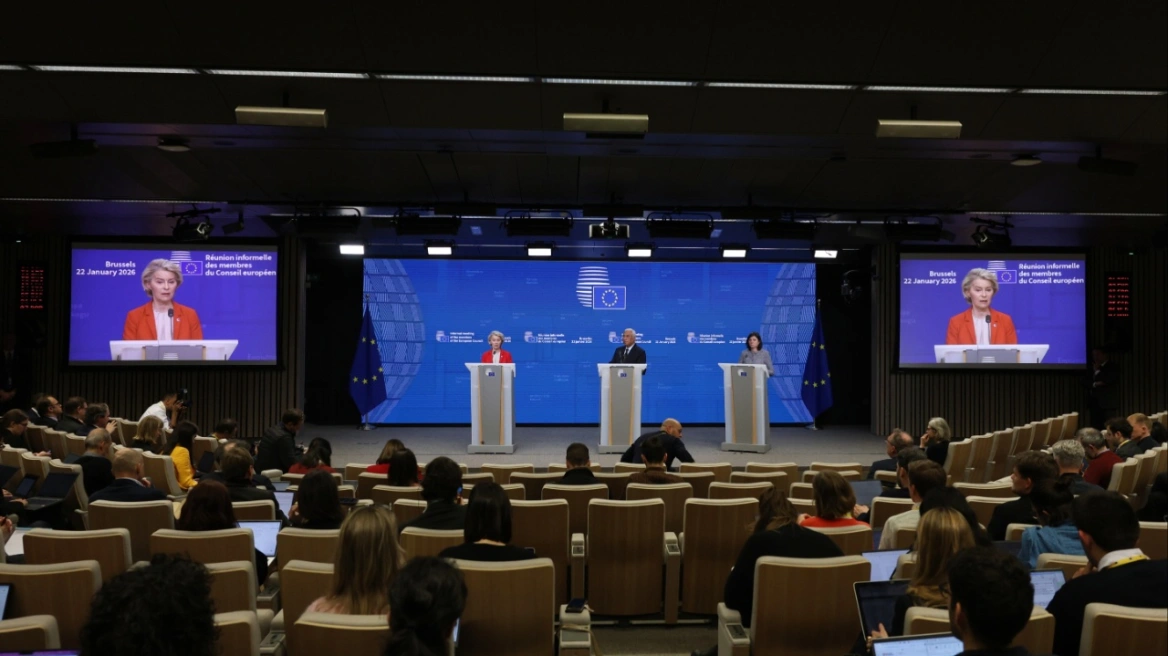






Greetings. Now, respecting my source at M.M., as well as the diplomatic correctness of the matter, I wrote to you yesterday that K.M. most likely would not “set foot” in Davos. Not because the plane couldn’t fly, of course, but because no European leader—apart from Orbán and the Bulgarian prime minister Zhelyazkov—went to Trump’s “Peace Council” at the beautiful and famous Swiss resort. Essentially, it appears that POTUS took a step back on Greenland, after of course telling us (the Europeans) that he will “watch over it for us,” but that’s how life and politics are. From M.M., whom I asked, they told me anyway: “Let’s wait to see Trump’s proposal for Greenland and discuss it again, because the information is confused.”
Meetings about the floods
– And since K.M. did not leave early in the morning at dawn for Davos, he convened a series of meetings. Not only about the sheep pox that was announced, but also about the floods in Attica. At some point, one of my people saw the regional governor Nikos Hardalias walking through the door of M.M., as well as a number of ministers such as Theodoros Livanios and Thanos Petralias. The Region’s flood-control projects are moving ahead, but with so much water having fallen, it is doubtful how much the urban infrastructure can withstand, while obviously funds will also be needed to restore the affected areas. Funds that are being disbursed fast-track, since Deputy Minister of the Interior Spanakis is approving relevant requests from mayors.
– Severely annoyed…
Since we touched on news about the prime minister, let me tell you that Mitsotakis—my (absolute) source from M.M. told me—is severely annoyed with those attacking his Deputy Minister for Environment and Energy, Nikos Tsafos. “The prime minister knows exactly who and why they are going after Tsafos, he surrounds him with absolute trust and will not tolerate business games against him,” the source told me. I know of one reason there is major friction with vested interests, and that is industrial electricity prices, but my source says it’s not only that. And perhaps the attacks are coming from within, without, and all around…
Competition in the South
– Since I mentioned Spanakis earlier, I should tell you that the battle for the preference vote continues under all conditions, even adverse weather ones. Beyond Spanakis, who was on the ground yesterday (so people could see him) speaking with mayors, Deputy Minister of Foreign Affairs Haris Theocharis—who is elected there but was in Davos—made a post to say that his family is safe (he lives in Upper Glyfada) and that he is in communication with the authorities. Also reappearing (as an MP) was meteorologist Yiannis Kallianos, who had been absent for a long time and dealing only with forecasts. A few days ago, in fact, he went and saw K.M., since… he judged that he should inform him about the intense weather phenomena that are coming.
Pavlos and the needle
– You will remember Geroulanos’ famous statement that “within the next two months we must move the needle,” which caused an uproar in PASOK. Geroulanos had set the end of last year as the milestone, and obviously the needle did not move much; on the contrary, PASOK appears in all polls to be losing strength. Yesterday, however, Geroulanos somewhat changed the tune, shifting the needle’s deadline to Easter. At the rate they’re going in PASOK, Merry Christmas—and shortly after, we have elections.
The Spaniards led by Santander and HSBC’s reservations
– For the second time in a few days, HSBC, in a report, warns that although the Greek economy will continue to do well, the positive developments in the Greek stock market have largely been priced in, upside margins are limited, and an upgrade to developed market status will most likely be a negative—rather than positive—catalyst. The British bank says this at a time when the General Index is already at +7% even before January has closed, and a series of stocks—from banks, energy and infrastructure companies, and many others—are continuing their six-year rally! Regardless of what British HSBC says, which is considered to be very close to the also British FTSE group, the rival camp of MSCI, and to what extent it will be confirmed or not, the essence is that the Greek stock market remains for foreigners the hottest shop in Europe, with shares continuing to rise, deals closing one after another, and everything pointing to even larger agreements ahead. Amid all this, it is no coincidence that the giant Santander dealt with Greece for the first time, choosing GEK TERNA. The Corporate & Investment Banking division (Santander CIB) is enormous, employing 3–4 thousand people worldwide, and is the international investment banking arm of Banco Santander, one of the largest financial groups globally. The fact that the Spaniards have begun to invest in our country may also be a harbinger of developments at the banking and corporate level.
High-quality investors in GEK TERNA
– And since GEK TERNA came up, it is worth noting that from the day Santander’s report became public—setting a target price for GEK TERNA at €49, i.e. +90% from the levels at which it was valued that day (€25.50)—the stock did not give any investor the opportunity to enter who was hoping for a “correction” to join the upward rally. The stock is heading full speed toward €32 (yesterday +2.79% at €31.7), but the important detail lies in the quality of the institutional portfolios now participating in the share capital. The new investors could be described in one word: “Ultra-conservative.” All the names are long-only investment funds, internationally known for the strict, thorough qualitative screening that precedes their investments. In the market they now say that GEK TERNA’s next goal is to stabilize its capitalization above €3.3 billion so that it can claim a place on our stock exchange’s showcase list, the MSCI Greece Standard.
January 26: bids for the 24 buildings at Tatoi
– Construction, real estate, hospitality, catering, and event organization. Large companies from the above sectors are now in a state of… battle ahead of the expression of interest for Tatoi, within the framework of the relevant tender process for the long-term concession of the 24 buildings and their surrounding area being run by the Hellenic Corporation of Assets and Participations (Hyperfund). Indicatively, from the real estate sector, declared interest already exists from the development company Hellenic Properties of Errikos Arones in cooperation with another group from the catering sector, while information indicates that there is serious interest from other players as well. The bids are scheduled for January 26, with a strong possibility of an extension given the complexity of the project and the collaborations that will be required. The buildings within the historic site of the former royal estate of Tatoi range from 30 sq.m. to 930 sq.m., with proposed uses including the creation of hospitality spaces/hotels, restaurants, a greenhouse, a winery, etc.
The “Gaza” of Glyfada and DEDDIE
– Undoubtedly, the storms that hit Attica from Wednesday afternoon until late at night were indeed what we call an “extreme weather phenomenon.” From that point, however, to some areas—such as Upper Glyfada—presenting an image of… Gaza, with stones, soil, mud, and whatever else one can imagine occupying roads and sidewalks, there is a distance. I do not know whether and which measures should or could have been taken by those responsible—mainly local government—to limit the consequences as much as possible and at least to have avoided the tragic death of the young woman who lost her life trying to reach her home. What I do know, however, is that a large part of the area, besides looking like a “bombed landscape,” was also plunged into darkness for nearly 7 hours, from 6:30 in the evening until 1 after midnight… With citizens left all those hours exposed to the cold as well. Certainly, with such devastation, there were damages and crews were working under extremely adverse conditions.
Capital injection into Fourlis’ subsidiary
– The new business child of the Fourlis Group appears to need support in its first steps. The company “Wellness Market,” under which the group is developing the Holland and Barrett wellness products chain in Greece, required capital support. Specifically, a capital increase was completed and the payment of €1.5 million into the company’s share capital was certified. Another capital increase had preceded earlier in 2025, this time €3.5 million. Fourlis, with Holland and Barrett (the largest vitamins and supplements company in Great Britain), entered a very competitive market by developing a network of 11 stores, including shop-in-shop locations within AB Vasilopoulos stores, as well as an e-shop. Only the large stores that opened first have reached break-even, and operational profitability is still being sought, as well as the mix of investments that will follow for the development of the chain.
Heraklion forms a united front for cruising
– The meeting between the CEO of the Heraklion Port Authority S.A., Minas Papadakis, and the CEO of Heraklion International Airport of Crete S.A., Nikos Anastasiou, was a deliberate move to synchronize two critical infrastructures at a time when decisions on homeporting in the Mediterranean are being “locked in” early and are difficult to change. Those in the know say that Minas Papadakis has a full understanding that major cruise companies today are demanding operational certainty. On the other hand, Nikos Anastasiou knows that the new airport cannot be limited to the role of a transport gateway if it wants to be meaningfully integrated into the high–value tourism narrative being promoted for Crete. Cruise companies no longer “buy” ports; they buy systems. At the political level, the move sends a message of autonomy. Heraklion, under the interests of the Grimaldi Group, is not waiting for someone to “grant” it the role of a homeport; it is attempting to build it on its own, laying the groundwork before major negotiations begin. In this sector, this is considered a prerequisite, not a detail. The question is whether the port–airport front will remain solid when the time comes for concrete agreements.
At daggers drawn over land at Ellinikon
– It is not all that common, at least in Attica, for two neighboring municipalities to… drag each other through the courts. The case concerns the Municipality of Elliniko–Argyroupoli and the dispute it has with the Municipality of Glyfada. In a recent announcement, the former municipality states that “the independent Greek Justice system, for the second consecutive time, has triumphantly vindicated our municipality in the legal dispute that the Municipality of Glyfada unjustifiably engineered against us, attempting to unlawfully strip us of our land.” “With decision No. 3228/2025, the Athens Multi-Member Court of First Instance rejected the second lawsuit as well, which the Municipality of Glyfada filed against us, seeking the seizure of specific territorial areas of our municipality, such as the Sourmena stadium and others, in order to appropriate them. After this second failure of the Municipality of Glyfada, which was accompanied by its condemnation to pay our municipality’s legal costs, we would like to assure the administration of the neighboring municipality of one thing: No matter how many more lawsuits they file against us, T H E Y W I L L L O S E. We have repeatedly stated—and unfortunately the facts confirm it—that we are unlucky with the ‘bad neighbors’ we have,” etc. Of course, the dispute that led the two municipalities to court concerns areas of Ellinikon, where, due to the investment being carried out by LAMDA, values have skyrocketed—along with, I presume, the fees or whatever other compensations the competent municipal authority may collect.
Taxes drive the wealthy out of London – Greece shines with Golden Visa
– In Britain, there is concern because London is losing its luster as a “haven for the wealthy.” The international consulting firm Henley & Partners measured that Britain is facing a sharp decline in its millionaire population—down 14.3% within one year. British millionaires fell to 2.6 million from 3.03 million in 2023. The Labour government has adopted policies of aggressive taxation of high incomes. Changes to capital gains tax, modifications to inheritance tax, and reforms to non-dom (non-domiciled resident) rules have created a hostile environment for wealth retention in Britain. Globally, only six countries recorded a decline in millionaires. Total wealth per adult in Britain fell by -3%. Of particular interest is the finding highlighted by Henley & Partners’ research that Greece is emerging as a top destination for Golden Visas because it offers not only tax incentives but also Mediterranean quality of life. As for the “hot issue” of “taxing great wealth,” supported by French and Greek Socialists, Britain’s example reminds us of the traditional Laffer Curve theory in practice: when taxes exceed a critical threshold, revenues fall because wealth travels. Britain still retains 4.4% of the world’s millionaires, but the trend indicates that a “wealth drain” is underway, while Greece benefits primarily thanks to the Golden Visa.
African ambassadors, the Greek government, and investment plans
– A few days ago at the Athenian Club, the signing of the Memorandum of Cooperation between Enterprise Greece and the Hellenic–African Chamber had all the makings of a diplomatic “show,” but behind the smiles and handshakes lie interesting messages for power centers. Behind the scenes, business circles report that the Memorandum is not merely a formal agreement. It opens the way for Greek companies thirsty for new markets, especially in sectors such as energy, agrifood, and construction. Discussions that took place after the speeches, away from the public eye, appear to have focused on specific projects and potential shared investment horizons, while African ambassadors made sure to emphasize the importance of their strategic presence in Greece. The picture that emerges is that Greece wants to play the role of a reliable European hub for Africa, while businesspeople see opportunities ahead that until recently were considered distant. Behind the polite wording, the real challenge will be the implementation of the Memorandum. Political interest is a given, but success will be measured by how quickly and effectively it translates into concrete deals and investments. As a diplomatic official pointed out, the event was both a display of political determination and an early field of economic chess moves for entrepreneurs who view Africa as the next major market. And as in any such game, the balance between the public and private sectors will ultimately determine who truly benefits.
In 12 months Greek shipowners ordered 137 ships, bought 185 secondhand, and sold 281
– In the maritime political gossip column, Greek shipowners made sure this week to remind friends and… competitors that the fleet renewal game is played on many boards. At Far East shipyards, Lavinia Shipping made a quiet yet resounding entry into the VLCC/Aframax club, “locking in” two 157,000 dwt tankers at DH Shipbuilding in South Korea. The price—around $86.5 million per vessel for delivery in 2029—shows that whoever moves first, wins, while the choice of scrubbers is by no means considered random by market insiders. At the same time, in the secondary (secondhand) market, the Greek footprint was everywhere. The 2007-built Suezmax SONANGOL NAMIBE passed into Greek hands for $34 million, confirming that “mature” ships still have their appeal when the price is right. By contrast, buyers from the Middle East were found for the LR1 PLOUTOS of Ionia Management, of Greek interests, at a price of $13.5 million—a move some interpret as careful portfolio cleanup. Containerships were not left out either: the 1,496 TEU feeder CONTSHIP BOX changed hands at $15.1 million, with Greek-controlled interests once again on the selling side. As they say in the market, “when you sell containers and build tankers, you know something.” And for anyone wondering whether all this is cyclical, the numbers speak for themselves. In twelve months, Greeks have ordered 137 newbuilds, bought 185 secondhand ships, and sold 281 units. Put simply, the Greek-owned fleet is changing its face.
Something (someone) caught G. Stassis’ eye in Davos
– The PPC (Public Power Corporation) share (+4.29% at €19.45) has been partying for days, with its market capitalization exceeding €7.18 billion. G. Stassis notes on LinkedIn that in Davos he had “a series of very interesting discussions with leaders from various sectors,” with the clear message that “strategic alliances are necessary to unlock scale, expertise, and speed.” The stock market is excited because rumors are circulating that in Davos he may have met potential tenants of the giga data center within the “integrated ecosystem of clean and flexible generation being created in Northern Greece.” At the same time, investments are beginning to pay off. PPC Romania (formerly Enel) is now producing 1.5 GW. In the coming months, the last lignite units of PPC will also be shut down. Renewable Energy Sources are delivering results. Yesterday, the wholesale electricity price of PPC was €167/MWh. On the same day, in neighboring Romania and Bulgaria, wholesale electricity prices were €276/MWh. In the immediately preceding days, with strong winds across the country, the wholesale price had dropped even to €80/MWh.
New announcements from Bally’s Intralot expected any day now
– With a target market capitalization of €2 billion, the BYLOT share (+0.77% at €1.05) is moving on the Athens Stock Exchange, and the density of transactions points to a new deal. The British betting market has recently been caught in a whirlwind of acquisitions, with Evoke, a subsidiary of William Hill, recording steady and significant gains (+10% yesterday). Rumors from London suggest that Bally’s Intralot is preparing an offer to acquire a British betting company, with Evoke considered the most likely target. Evoke announced a strategic repositioning in the market in December that could lead to the sale of the entire group or part of its assets. The increase in gambling taxation announced by British Chancellor of the Exchequer Rachel Reeves will add £125–135 million to annual tax costs starting in April 2026. The tax on online casinos is nearly doubling from 21% to 40%, while betting tax is rising to 25%. Intralot completed the acquisition of Bally’s International Interactive division in October for €2.7 billion, with Bally’s retaining 58% of the Greek company IGamingExpert. The new group has announced that it is seeking expansion into mature markets. William Hill remains a premium brand with 1,300 shops in the United Kingdom and a strong online presence. For Bally’s–Intralot, organic entry into the British market would be very costly. A potential acquisition of Evoke would open the door to entering a market that is heavily taxed but does not have the restrictions of U.S. legislation.
A dozen records at the Stock Exchange
– A total of 12 large- and mid-cap stocks closed at new multi-year or all-time highs, pushing the Athens Stock Exchange closer to 2,300 points, a target set by several analysts for 2026. And we are still in January. Among them are two banks, while most are heavyweight stocks from the energy and construction sectors. Among the systemic banks, Piraeus Bank “locked in” its presence above €8 and climbed to its highest point since mid-March 2021. Bank of Cyprus reached €8.7 for the first time. PPC reached the €19 mark, closing at an 18-year high—specifically at levels last seen intraday in August 2008 and in closing terms in July of the same year. At the same time, the group’s market capitalization exceeded €7 billion. GEK TERNA, logging seven consecutive rising sessions, continues to renew its 26-year record. It reached €31 and further narrowed the gap from its all-time highs. €10 has become the new normal for Aktor, at new all-time highs, along with Motor Oil, which broke through the €32 barrier, and Titan, which is approaching €56. Cenergy touched €18, while Athens International Airport reached €11.3 for the first time. AVAX rose above €3.5 and, after the downward pause of last Tuesday, returned to its 16-year record path. Dimand continued its strong performance, closing at €13.3, the best levels since early March 2023. Finally, Ideal climbed to €6.5 for the first time since March 2024, driven by a capital return of €0.15 per share to be distributed next week.
New offices for EUROPE
– New luxury offices of EUROPE Insurance will be inaugurated by the Group’s management next week, on January 29. More than 1,000 square meters on Kifisias Avenue, with fully modern infrastructure and high-spec equipment. The stock market value of EUROPE Holdings exceeded €306.7 million (+1.42% at €2.15). Reliable information indicates that, regarding the insurance company, a significant increase of +25% will soon be announced, both in turnover and in profitability for 2025. Starting this year, there will also be positive synergies in the insurance sector with the Group’s other companies, as well as with significant private investors who now participate in the shareholding structure.
Trump, the TACO tactic, and why Cuba now takes priority
– The revealing article in yesterday’s Wall Street Journal and the analyses by Wall Street traders on the TACO tactic (“Trump Always Chickens Out”) followed by POTUS appear to coincide. Trump’s Greenland firework was used as a diversion because, at the present stage, the president’s priority is “to eliminate the last communist regime in the Western Hemisphere just 150 kilometers from Florida.” According to WSJ analysis citing anonymous officials, Cuba is considered vulnerable after losing its main ally, Venezuela, which had been supplying it with cheap oil. The WSJ report states that the U.S. government is seeking officials within the Cuban regime willing to cooperate in overthrowing communism by the end of 2026. The plan is part of the new National Security Strategy 2025, which brings the Western Hemisphere back to the center of U.S. policy. Secretary of State Marco Rubio, a Cuban-American and hardline critic of the Díaz-Canel regime, plays a central role. The Cuban diaspora in the U.S. constitutes a strong electoral force for Trump, pressing for major change. On the other hand, Wall Street traders are trying to interpret the president’s TACO policy. It is a cycle that begins with aggressive tariff threats or grandiose statements that trigger panic selling in markets and ends with easing of tensions, postponements, delays, or negotiations that are immediately followed by a market rally. The TACO analysis (Trump always backs down) is not based on economic indicators or models, but on simple empirical observation of events.
When everything resembles the 1980s
– Bloomberg published an interesting chart. The Bloomberg Precious Metals Subindex has skyrocketed with a +93% year-on-year increase. Such performance has not been recorded since the inflationary era of 1980. Yesterday, the index price exceeded 413,530 points, tracing a curve that mirrors the historic explosion of 45 years ago. Gold has risen from around $2,000 in early 2024 to over $4,450 in January 2026, while silver shows an even more dramatic performance with gains exceeding +140%, reaching above $74 per ounce. Recently, silver surpassed $90 for the first time and at one point reached $91.55. The first obvious explanation is geopolitical turmoil, which fuels demand for safe havens. However, there is also accelerating de-dollarization of transactions, with central banks in Asia and the Middle East abandoning U.S. bonds in favor of physical gold. Finally, there is a technical detail: silver now represents 9% of the Bloomberg Commodities Index, compared to an original target of 4%. This means more than $5 billion will have to be sold during rebalancing. For gold, the corresponding pressure approaches $6 billion. Regardless of fears of a technical correction, Goldman Sachs forecasts gold at $4,900, while HSBC targets $5,000 by June. In the corresponding explosive rise of 1980, the collapse came after aggressive monetary tightening by then-FED Chairman Volcker. Paul Volcker went down in history as the Federal Reserve Chairman (1979–1987) who “killed” inflation. Serving Presidents Carter and Reagan, he raised dollar interest rates to 20% (!) and reduced inflation—from 14% to 3%—through blood and tears. Today, the U.S. Federal Reserve is moving in the opposite direction, under unbearable pressure from political leadership, with markets pricing in two rate cuts within the year.
The Bank of Japan makes history
– As you read these lines, it is very likely that the meeting of the Bank of Japan’s Board of Directors has concluded and that the announcement has caused a stir. If market estimates prove correct, today the Japanese central bank is announcing a very sharp tightening of its monetary policy at a time when all other major central banks are easing. If information about a dramatic interest rate hike to 1% is confirmed, it would mark a change in policy spanning the last 50 years. The “wise elder” governor Kazuo Ueda has repeatedly stated that the central bank is ready to raise rates if economic forecasts are confirmed. Until yesterday, yen interest rates stood at 0.75%, the highest since 1995. Ueda has emphasized that real interest rates remain “significantly negative,” with inflation consistently above 2% for a fourth consecutive year and wages rising by +5.25%. Prime Minister Sanae Takaichi has called elections for February 8 and promises voters major fiscal expansion, including cutting VAT on food to 0%. Japanese bond yields have already surged to 2.3%, higher than in 1999, as investors worry about fiscal sustainability with debt at 230% of GDP. It is obvious that if Takaichi wins the election, political pressure for low interest rates will become suffocating. All of this affects not only Japan but markets across the globe. The yen, trading around 155–158 against the dollar, would move toward 145–150 with rate hikes. The notorious “carry trade”—borrowing yen to invest in higher-yielding assets elsewhere—will become even more difficult. Many funds will need to liquidate positions worth billions, including Japanese bonds. The BoJ is already implementing a program of unlimited purchases to control yields, but an interest rate increase would neutralize any stabilization effort. Ten-year yields could surge to 2.8%–3%, levels not seen since the late 1990s.
Ask me anything
Explore related questions