




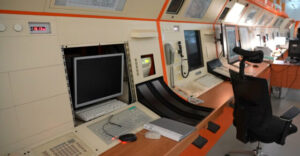
08:59 a.m. Frequencies in the Athens FIR fill with noise. Nearly 70 aircraft lose all contact with control.
For 59 minutes, a “zero rate” is imposed. Greek airspace closes—for the first time. In the new episode of Medusa, we investigate what happened that morning and how an outdated system reached ground zero.
“When many aircraft lose contact with the Area Control Center, the system becomes dangerously stressed,” says Spiros Panousos, an Airbus pilot.
“A communications outage forces you to deviate from the plan without coordination. That’s when things get difficult.”
The report refers to “digital noise” and transmitter desynchronization. “We cannot be absolutely certain about the cause due to the age of the system,” admits Christos Dimas, Minister of Infrastructure and Transport.
“The critical issue is not flight safety, but capacity—how many aircraft you can handle.”
Air traffic controllers are sounding the alarm.
“With the tools we have, we handle fewer aircraft. If we were operating in Germany, the airspace would close daily,” says Panagiotis Psaros, president of the Air Traffic Controllers.
Olga Toki, vice president of the Hellenic Air Traffic Controllers Association, is unequivocal: “When you have a 30-year-old system, it can happen again. We’re not gambling with safety.”
From the engineers’ side, the picture is equally concerning, with a different angle.
“The problem lies in the telecommunications network. The system held up, but it became desynchronized,” says Konstantinos Kanderakis, president of the Association of Electronic Engineers for Air Traffic Safety at the HCAA.
He warns: “What’s needed is a Marshall Plan—do in three years what wasn’t done in fifteen.”
The supervisory authority rules out a cyberattack but confirms a structural weakness.
“There was no interference. There was desynchronization due to age,” notes Kostas Masselos, president of the Hellenic Telecommunications and Post Commission (EETT).
And from the HCAA’s management, the admission is clear.
“We lost data lines and radar. The major problem was that we couldn’t communicate with the aircraft,” says Giorgos Vagenas, deputy governor of the HCAA.
“By the end of 2028, we want to have a completely different picture.”
What went wrong? How resilient is the system today? And how close did the Greek sky come to something extreme?
Ask me anything
Explore related questions