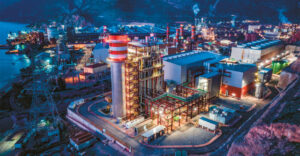
Five kilograms may seem negligible in terms of industrial production. Yet, the first 5 kilograms of gallium recently produced by Metlen, announced via social media by Evangelos Mytilineos, signal far more than just a number on a scale.
Gallium is not an ordinary metal. It is one of the “invisible” materials of modern technology, essential for semiconductors, telecommunications, high-efficiency photovoltaics, LEDs, and defense industry applications. Even tiny quantities are crucial, and the absence of gallium can halt the production and development of critical technologies.
The China Factor
Until now, Europe has been almost entirely dependent on imports, primarily from China. This is where the small pilot production at Metlen’s facilities in Asprá Spítia, Boeotia – where Alumínion of Greece operates – gains strategic and economic significance, implementing an investment of around €300 million. Full-scale industrial production would significantly reduce dependence on third countries, proving that European gallium production is not just theoretical but is beginning to take shape.
When China imposed restrictions on gallium and germanium exports in July 2023, global supply chains experienced immediate disruptions, with gallium prices in Europe surging over 40%.
According to the Atlantic Council, a prominent independent think tank with close access to U.S. policy circles, critical raw materials are increasingly seen as a matter of national security.
Gallium, while used in tiny amounts, is essential for radar, guided weapons, satellites, and advanced electronic warfare systems. The United States has no domestic production or strategic reserves, making it highly vulnerable to supply restrictions. The country consumes about 20 tons annually – a small but critical amount for defense and technological infrastructure. Although gallium occurs in trace amounts in industrial flows like alumina and zinc, without organized recovery, it is lost as waste. China controls nearly 99% of primary production, using export restrictions as a strategic lever, making urgent action crucial.
Metlen is breaking these chains. “Domestic gallium production is an extremely important development,” notes Dionysis Goutis, Director General of the Hellenic Geological and Mining Research (HGMRI), emphasizing its clear geostrategic impact. Neither Europe nor the U.S. currently produces gallium, leaving the West dependent on Asia for a metal with a vast range of applications. Projections indicate that by 2028, Europe’s new production capacity could meet a significant portion – or even the entirety – of the EU’s annual demand, estimated at 50 metric tons.
The Significance of Greek Production
This quantity can be met by the Boeotia production line. “We’re talking about a relatively small amount – practically two trucks,” says the HGMRI head, highlighting its strategic importance. Gallium does not exist in standalone ore; it is found in trace amounts within other minerals, mainly bauxite (used for aluminum) and, to a lesser extent, zinc ores.
During processing, gallium accumulates in liquid residues, from which it is extracted through specialized purification methods. “Producing it is a major success, not just for the company, but for the Greek industry as a whole.”
Securing gallium production allows the EU to reduce dependence on geopolitical pressures and lays the groundwork for investments in advanced technologies. “You cannot decide to invest in 5G or integrated circuits without guaranteed access to gallium,” Goutis emphasizes.
High-Value Commodity
Gallium is considered a commodity, with value set by international markets, like oil, gas, copper, or aluminum. Its limited production and geographic concentration make it rare, so even small amounts carry disproportionate significance when geopolitical balances shift.
This announcement comes as the EU strengthens resilience via the Critical Raw Materials Act (CRMA), aimed at reducing dependency on third countries for critical materials like gallium, lithium, and rare earths. The plan mandates that by 2030, Europe should source at least 10% of its needs from domestic mining, 40% from EU processing, and 25% from recycling, while limiting dependence on a single country to 65% for any material.
The first 5 kilograms produced at Metlen’s facilities confirm that European policy can stand on its own and be implemented industrially. The real question is whether Europe will provide financial tools to scale production from 5 kilograms to 50 tons, establishing a reliable supply chain – something that has not yet materialized despite rhetoric about reducing dependence on China.
A 650% Rally in Seven Years
Gallium’s strategic significance is reflected in its price surge. Today, its value stands at $2,060.40 per kilogram, at historic highs, based on international spot indexes for high-purity gallium. Annual growth reaches 119%, reflecting tight supply and geopolitical uncertainty.
Since early 2021, gallium prices have risen 387%, and since January 1, 2020, total growth reaches 590%. Compared with 2018, when it traded at $274/kg, the increase is 650% over seven years, highlighting how critical raw materials diverge from traditional stock markets.
Wide Applications
Gallium may lack the allure of gold or the recognition of lithium, but without it, many modern technological systems simply would not function. It is not visible in daily life but is a key component of advanced materials.
Thanks to gallium, smartphones are faster, more energy-efficient, and capable of handling massive data volumes. 5G network antennas require high-performance, low-loss materials. Gallium is also essential for advanced photovoltaics, satellites, and installations where efficiency is critical. The International Energy Agency recognizes such materials as crucial for reducing energy losses and improving overall performance.
Gallium is indispensable for defense and aerospace, used in radar, communications, satellites, and precision equipment. Both the U.S. and the EU list it as a strategic material.
Alternatives are limited. Recycling remains low, and new production units require significant investment, expertise, and time. Gallium exemplifies how technological progress, green transition, and defense readiness depend on materials most consumers never even know exist.
The Greek Player
Against this backdrop, the EU did not just identify the problem. About two years ago, it sought European industrial players capable of turning critical materials strategy into production. This is where Metlen comes in.
The company operates a vertically integrated model from bauxite mining to alumina and aluminum production. This allows gallium recovery as a byproduct without new mining, positioning Greece as a key link in Europe’s strategic autonomy for critical materials.
Landmark Investment
Metlen will invest €295 million, including €90 million from the European Investment Bank, to build a gallium production unit integrated into its existing industrial chain. The pilot phase has already produced the first 5 kilograms at Alumínion of Greece’s facilities.
Mytilineos has expressed interest in other critical materials, like germanium and scandium, also bauxite byproducts, with pilot programs planned for both. The pilot stage tests technology and recovery processes, enabling optimization before full-scale production in 2028.
Metlen aims to treat gallium not merely as a commodity but as a strategic material under EU security frameworks, vital for industrial and defense infrastructure. The annual projected production of 50 tons, at current prices, is valued at roughly €100 million.
Greek government sources note that gallium production is part of a broader strategy to strengthen high-value industrial activity in recent years, especially in processing and mining, marking another milestone for the domestic industry.
PHOTO: Getty Images / Ideal Image
Ask me anything
Explore related questions