





Bilateral technical discussions, set against the framework of the Hellenic Armed Forces’ 12-year armaments program, were reinvigorated by the visit of Israel’s Defense Minister, Israel Katz, to Athens in mid-week. The visit sent multiple messages across the Southeastern Mediterranean—messages that did not go unnoticed by neighboring Turkey, which is closely monitoring the accelerating pace of Greek-Israeli cooperation, particularly as it is increasingly described as an “alliance.”
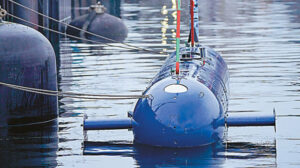
Beyond broader regional challenges and bilateral relations discussed between Greece’s Minister of National Defense, Nikos Dendias, and his Israeli counterpart, talks also focused on the “Achilles Shield” command-and-control software and the “Blue Whales”—the BlueWhale (ELI-3325) unmanned submarines—intended to enhance the Greek Navy’s anti-submarine warfare capabilities.
Maritime defense and unmanned systems
Discussions between the two defense establishments have steadily progressed in recent years, reaching a level that military sources describe as highly mature. Nevertheless, on the Greek side the process remains at the consultation stage. The BlueWhale system, meanwhile, has attracted pan-European interest, with Germany reportedly expressing similar intentions.
The potential initial procurement of a single BlueWhale unmanned submarine—measuring 10.9 meters in length and weighing 5.5 tons—could pave the way for a larger acquisition in a subsequent phase, possibly involving up to six units for the Hellenic Navy. However, no final decision has yet been reached, despite the platform’s enhanced capabilities and its ability to project power across the Aegean.
Furthermore, the fact that the BlueWhale is produced by ELTA Systems, a subsidiary of Israel Aerospace Industries (IAI), further strengthens bilateral ties. In parallel, cooperation between IAI and Hellenic Aerospace Industry (HAI) has reportedly led to the integration of the Greek anti-drone system “Kentauros” into the advanced BARAK-MX air and missile defense system.
The “secrets” of the BlueWhale submarines
According to the manufacturer, the BlueWhale™ unmanned submarine is designed for a wide range of critical missions, including anti-submarine warfare (ASW), mine countermeasures (MCM), and covert intelligence gathering in both open seas and complex coastal environments. It can operate as a forward submarine scout or support special forces through clandestine underwater surveillance and reconnaissance missions.
“Alliance” rather than cooperation
The elevated level of Greek-Israeli relations was underscored by the statements of Israel’s defense minister. “Anyone who dreams of turning the region backward, imposing control through terrorism or rebuilding empires at the expense of sovereign states will face a determined alliance of free, strong states capable of defending themselves,” Katz said, clearly referencing the Southeastern Mediterranean and deliberately describing bilateral defense ties as an “alliance” rather than mere “cooperation.”
He added that Israel is “committed to strengthening this alliance and views it as a lever for deepening political, defense, and strategic relations, as well as for reinforcing influence and stability among the three countries in the Eastern Mediterranean.” According to seasoned analysts, this framing helps explain the reaction of the Turkish press that followed, particularly coverage referencing statements by Defense Minister Nikos Dendias on Greece’s extension of its territorial waters—a move he described as a “unilateral and sovereign right.”
In this context, the Turkish newspaper Hürriyet spoke of a “renewal of provocations in the Aegean by Athens,” adding that “Dendias makes a statement on the 12-mile issue.” The article was accompanied by a map of the Aegean Sea, sourced from Anadolu Agency, depicting islands definitively ceded to Greece under the Treaties of Lausanne (1923) and Paris (1947), which Turkey claims should remain demilitarized.
For his part, Dendias avoided any direct references to Turkey during his meeting with his Israeli counterpart. Instead, he emphasized synergies in the defense industry, noting: “We are interested in and have agreed to strengthen cooperation between the ELCC and the corresponding Israeli institutions. We expect a great deal from this collaboration.”
Ask me anything
Explore related questions


