





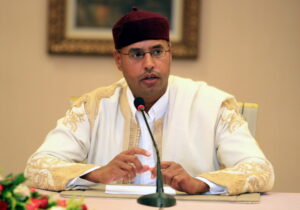
Libyan prosecutors say they have launched an investigation into the killing of Saif al-Islam Gaddafi, the son of Libya’s longtime leader Muammar Gaddafi.
In a statement, the prosecutor’s office said the 53-year-old—once widely regarded as his father’s heir apparent—was killed following a “confrontation” with four unidentified gunmen who stormed his home in the town of Zintan. Authorities said he died from gunshot wounds and that efforts are underway to identify and apprehend the attackers.
However, an alternative account was offered by his sister, who told a Libyan television channel that Saif al-Islam Gaddafi died near the Libyan border with Algeria.
For many years, Saif al-Islam was considered the most powerful political figure in Libya after his father, Muammar Gaddafi, who ruled the country from 1969 until he was overthrown and killed during the 2011 uprising.
Born in 1972, Saif al-Islam played a key role in Libya’s engagement with Western governments in the early 2000s, helping to normalize relations after years of international isolation. Although he never held an official government post, he was deeply involved in policy decisions and high-level negotiations, including talks that led to Libya abandoning its nuclear weapons programme.
Following the collapse of the Gaddafi regime, Saif al-Islam was accused of involvement in the violent suppression of anti-government protests in 2011. He was captured by militia forces and held for nearly six years in Zintan.
The International Criminal Court sought his arrest on charges of crimes against humanity. In 2015, a Tripoli court sentenced him to death in absentia. He was released two years later in eastern Libya under an amnesty law.
Although he had previously said he did not intend to succeed his father, Saif al-Islam announced in 2021 that he would run for president. The election was later postponed indefinitely.
Ask me anything
Explore related questions


