





Australia—where the Greek language journeyed with migrants and took root through memory, family, and community—stands at the center of academic and diaspora Greek interest this year.
From 6 to 11 September, Sydney will host the 12th International Summer University “Greek Language, Culture and Media”, held under the auspices of H.E. the President of the Hellenic Republic, Mr. Konstantinos Tasoulas, and the President of the Republic of Cyprus.
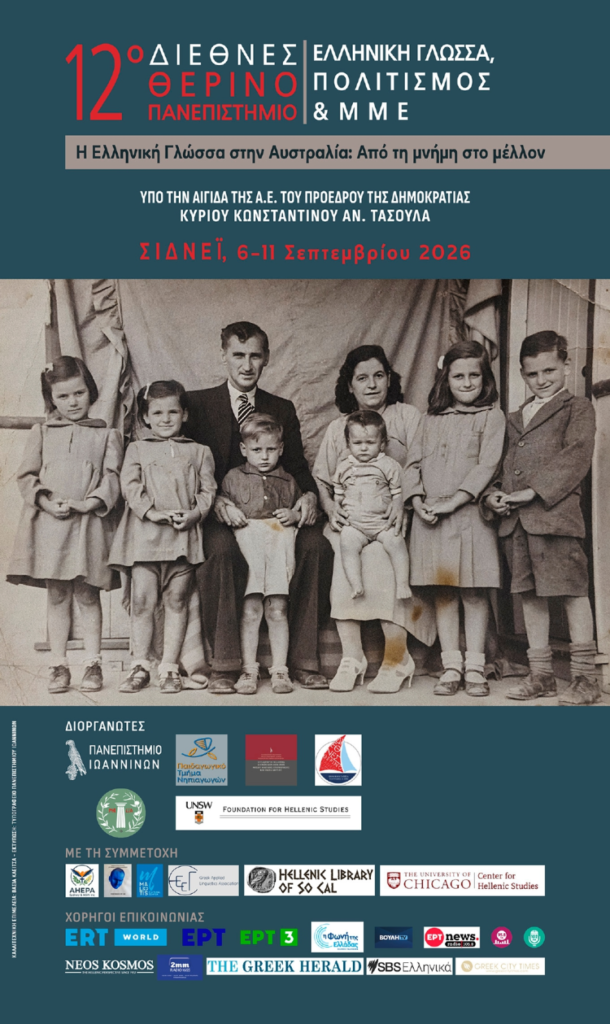
The program is organized by the Laboratory for the Study of Social Issues, Media and Education of the Department of Early Childhood Education, School of Education, University of Ioannina, in collaboration with the Greek Studies Programme at the University of New South Wales (UNSW) and Unity in Philia, with the participation of major international and Greek diaspora organizations.
These include the Foundation for Hellenic Studies (UNSW), AHEPA Sydney & NSW, the International Society of Friends of Nikos Kazantzakis – Sydney Branch, numerous diaspora organizations and institutions, the Maliotis Cultural Center of Hellenic Holy Cross, the Hellenic Association for Applied Linguistics (GALA), the Southern California Library, the Center for Hellenic Studies at the University of Chicago, Study in Greece, and the Australian Hellenic Educators Association.
From Memory to the Future of the Greek Language
This year’s Summer University is titled “The Greek Language in Australia: From Memory to the Future”, focusing on the enduring presence of Greek within the Greek-speaking communities of the fifth continent and exploring prospects for its sustainability in the digital age.
The program will be hosted at the Rex Vowels Theater, a 300-seat auditorium within the Department of Electrical and Mechanical Engineering at UNSW, one of the world’s leading universities, founded in 1949. The venue is equipped with state-of-the-art hybrid learning technology and is fully accessible to people with disabilities.
The program is implemented through the Centre for Training and Lifelong Learning (K.E.DI.BI.M.) of the University of Ioannina.
Focus on the Diaspora and the Media
The Summer University program addresses a broad spectrum of themes reflecting the contemporary challenges of Greek-language education and communication in Australia, including:
The past, present, and future of the Greek language in Australia
Greek-language education
The role of communities, churches, organizations, and associations in language preservation
Innovative pedagogical approaches to teaching Greek
Digital technologies and hybrid learning models
Greek-language press, radio, television, and digital media in the diaspora
Synergies between universities, communities, and institutions
The role of business in ensuring the sustainability of the Greek language in Australia
An Event with an International Footprint
After 11 years of recognized success, the International Summer University continues its tradition of outward engagement and strategic partnerships with leading educational, cultural, and media institutions worldwide.
In previous years, the program has been supported by organizations such as the Center for Hellenic Studies at Harvard University, the Greek Delegation to the European Parliament, the Association of European Journalists, the Orthodox Academy of Crete, Club de la Presse Européenne (Paris), the Centre Culturel Hellénique, the Instituto de Letras of the University of Rio de Janeiro, Macquarie University, the Macquarie Greek Studies Foundation, APE-MPE, Study in Greece, the University of Chicago, and many others.
Over the past two years, the program was held with great success in Boston, in collaboration with the Maliotis Cultural Center of Hellenic Holy Cross and its Executive Director, Ms. Chrysoula Kourkountis.
The 2026 Summer University will bring together academics and researchers from Greece and abroad, intellectuals, writers, artists, as well as directors and journalists from diaspora media outlets.
Participation is free of charge and open to undergraduate and postgraduate students, doctoral candidates, teachers, journalists, and professionals with related interests, within the framework of lifelong learning. Participants will receive certificates of attendance and educational materials, while all proceedings will also be broadcast online.
Visibility and Symbolism
The 2026 program is being promoted through a television and radio campaign on public broadcasting, the Parliament Channel, and diaspora media.
The television spot features director and actor Achillas Karazisis, while the poster depicts a Greek immigrant family from the 1940s. Among them appears, as a child, Mrs. Georgia Babdeimou-Thevaiou, to whom the Organizing Committee extends its sincere thanks for granting permission to use the photograph.
The Founder and Scientific Coordinator of the program is Professor Nikoletta Tsitsanoudi-Mallidi, Professor of Linguistics and Greek Language at the University of Ioannina, Dean of the School of Education, and Head of the unit “Greek Language, Culture and Media.”
The organizational coordination in Australia is led by Dr. Vassilis Adratas, Head of the Greek Studies Program at UNSW and Coordinator of the Islamic Studies Program at Western Sydney University.
Ask me anything
Explore related questions