




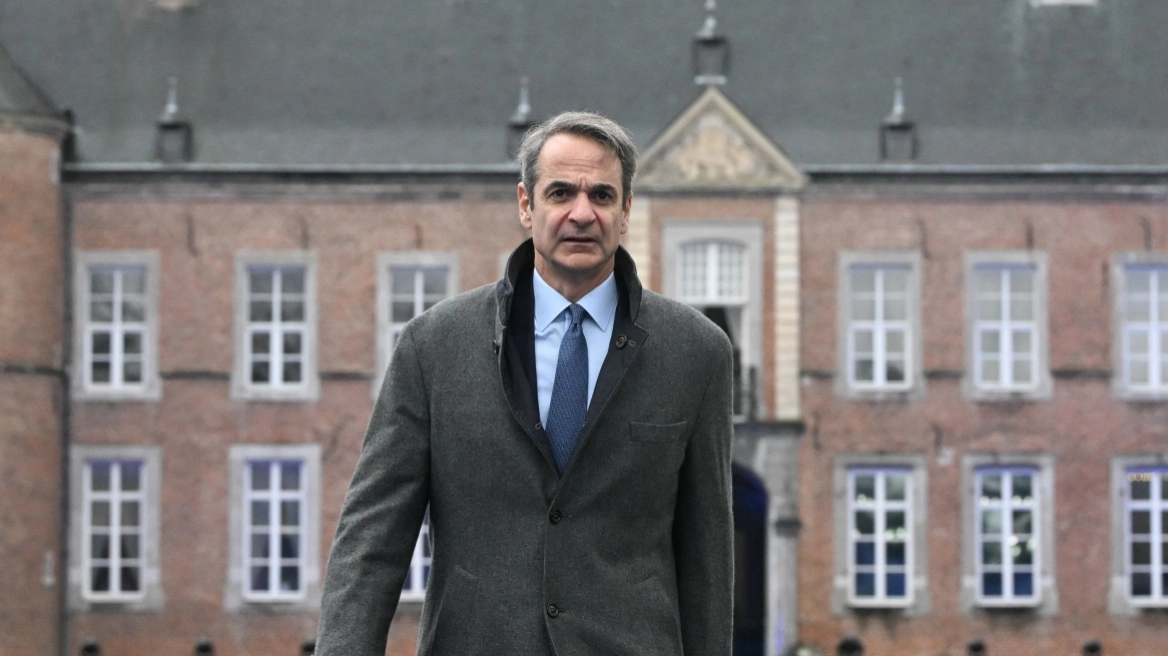
Greece is approaching the informal summit taking place today in Belgium with concrete proposals to reduce European bureaucracy in order for the single market to function better and for competitiveness to benefit both businesses and consumers, Prime Minister Kyriakos Mitsotakis said upon arriving at Alden Biesen Castle in Flanders, where the 27 European Union leaders are meeting.
“Competitiveness is an abstract concept, and if it is not combined with better jobs and lower prices, it will be difficult to gain the social support necessary for the critical decisions we are called to make,” the Prime Minister added.
He also said that he will have the opportunity to focus on the energy market, which is clearly not functioning adequately in the EU. Greater integration is needed to achieve better energy prices for consumers and businesses.
Full statement by Kyriakos Mitsotakis
Europe must improve its competitiveness if it wants to support its social model, invest in defense, and protect itself against the climate crisis. This is the main focus of the extraordinary European Council, which will begin shortly.
Greece comes to this discussion having submitted very specific proposals to reduce European bureaucracy, improve the functioning of the single market, and ensure that competitiveness ultimately benefits both businesses and European consumers.
Competitiveness by itself is a rather abstract concept if it is not combined with more and better-paid jobs and, above all, with better and lower prices in the European market to tackle the cost-of-living crisis. If these conditions are not met, it will be difficult to gain the social support necessary for the critical decisions that must be made from now on.
I will have the opportunity to focus more on issues in the energy market. It is clear that today the energy market in the European Union does not function satisfactorily. We need greater integration in the energy market so that, ultimately, energy prices can be lower across Europe, both for European consumers and European businesses.
What is being discussed today in Belgium
The leaders of the European Union are meeting today in Belgium in an informal summit to reach common points aimed at strengthening the single market and the competitiveness of the European economy while reducing the EU’s economic dependence on third countries.
The main topic of the meeting is the status quo, which demonstrates the EU’s complete inability to respond to current geopolitical and geoeconomic developments and, consequently, the need for the “27” to provide answers.
The answers to this deadlock: three plus one.
The first is France, which, among other things, calls for simpler rules, “European preference” for critical industries, Eurobonds for defense, technology, and artificial intelligence, as well as a stronger euro.
The second is the new German-Italian axis, which calls for a European strategy to boost European industry without protectionism, rejecting both Eurobonds and the prospect of a stronger euro, which would primarily hurt German exports.
The third is the European Commission, which, as the EU’s executive body, emphasizes that the main problem is that the single market is, in practice, fragmented and calls on member states to advance further in economic, political, and defense cooperation—not necessarily collectively, but through “coalitions of the willing.”
The fourth is former European Central Bank President and former Italian Prime Minister Mario Draghi, who strongly advocates for the federalization of the EU, warning that without deep integration of the single market, Europe cannot finance its innovation, industry, and defense.
Macron and the “Merzoni” duo
Considered politically weakened in France and sidelined in Europe by the new alliance of German Chancellor Friedrich Merz and Italian Prime Minister Giorgia Meloni—the duo called “Merzoni”—French President Emmanuel Macron has called for a Europe with higher public investment, reduced dependence on trade partners, diversification of supply chains, stronger support for domestic industry through “buy European” rules in public procurement, and less bureaucracy.
However, in Berlin and Rome, Macron is no longer considered the preferred interlocutor. The German Chancellor and Italian Prime Minister recently agreed to attend the informal summit with joint positions. Their message: Europe is losing the economic growth race.
According to Berlin and Rome, since 2000, Europe’s economy has grown much more slowly than those of the U.S. and China. This threatens living standards in the EU and its ability to make independent decisions. According to the German-Italian axis, the EU is essentially sabotaging itself by voting for and implementing its own rules.
The fragmentation of the Single Market
The EU Single Market has 450 million consumers and represents 18% of global GDP—which, as Mario Draghi has pointed out, should be the EU’s “bazooka” in its arsenal. Nevertheless, the barriers are enormous, resulting in a market that is single in name only, as in practice, its fragmentation equates to 44% tariffs on goods moving within the EU and 110% on services.
A few examples of Single Market fragmentation illustrate the enormous task facing the “27” and the Commission, despite the Draghi and Letta reports highlighting these issues:
European engineers, architects, and lawyers often face time-consuming procedures to have their studies or professional qualifications recognized in order to work in another member state, despite EU directives on free movement.
The situation in retail within the EU is equally frustrating. It is estimated that there are 6,000 different national rules for professional services, and although construction represents about 11% of EU GDP, only 5% of public contracts are awarded to companies from other member states.
In some cases, it is easier for European businesses to invest outside the EU than within it. According to the Draghi report, deeper integration in services, energy, capital markets, and digital technology could boost member states’ GDP by 3% to 9% annually.
Another key issue expected to be raised at today’s meeting is the potential revision of competition rules. For example, when two or more European companies seek to merge, the relevant competition authorities—European or national—primarily examine the domestic market share, which makes the creation of “European giants” capable of competing with American or Chinese companies inherently difficult.
Within this context, the European Commission will be asked to draft and submit a “competitiveness roadmap” for the completion of the single market by 2028, which will be approved by EU leaders at the European Council in March.
Ask me anything
Explore related questions