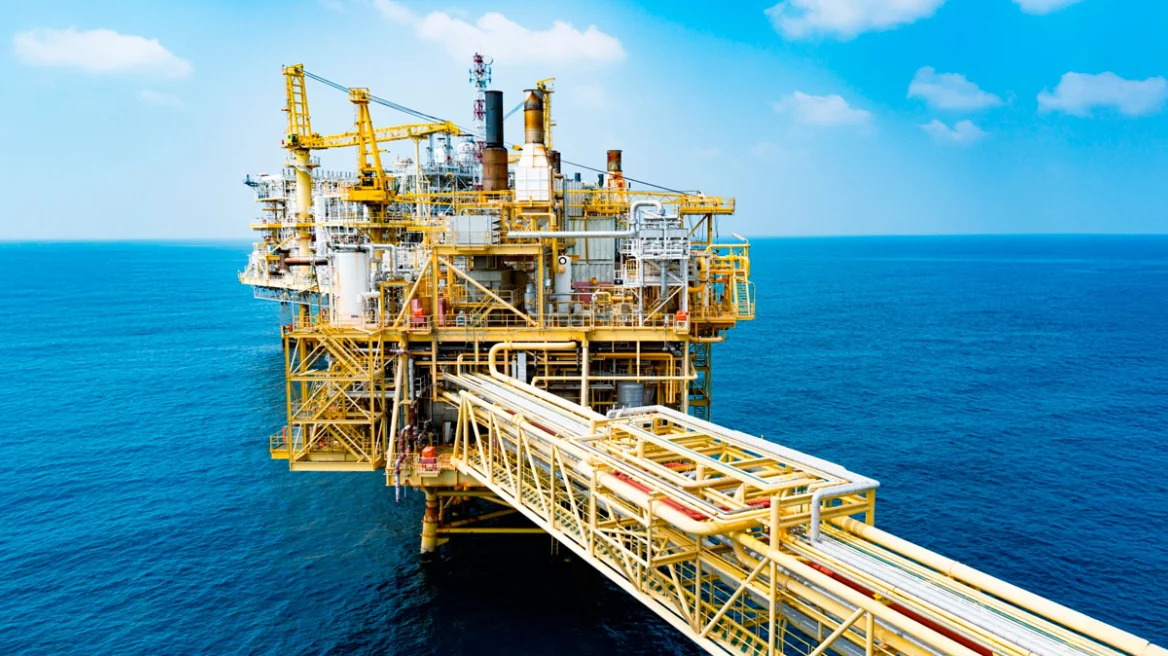
A new chapter in the exploitation of domestic hydrocarbons, strengthening expectations for the country’s energy self-sufficiency, opens with today’s signing of four concession agreements between the Greek state and the Chevron–HELLENIQ ENERGY consortium, marking the substantive restart of exploration in Greek maritime areas.
The agreements concern the areas “South Peloponnese,” “A2,” as well as the offshore blocks “South of Crete I” and “South of Crete II,” which are among the country’s most geologically promising zones.
The signatures will take place at a special ceremony to be held at the Maximos Mansion at 11:00 a.m., in the presence of the prime minister, the political leadership, and the heads of the contracting companies. On behalf of the concessionaires, the contracts will be signed by Chevron Vice President Gavin Lewis and HELLENIQ ENERGY CEO Andreas Siamisis, while the Greek state will be represented by the Minister of Environment and Energy, Stavros Papastavrou, and the CEO of the Hellenic Hydrocarbon and Energy Resources Management Company, Aristophanes Stefatos.
Following the ceremony at the Maximos Mansion, an event is expected to take place at the Acropolis Museum, during which the main pillars of the research program and the next steps will be presented.
How the path opened for Chevron’s entry
The foundations for Chevron’s presence in the Greek hydrocarbon market were laid last September, when the company, in a consortium with HELLENIQ ENERGY, emerged as the sole bidder in the tender launched by the Greek government for the four offshore concessions south of Crete and the Peloponnese. This development confirmed the growing investment interest in Greek maritime areas and led to today’s formalization of the contracts.
The entry of Chevron, one of the world’s largest energy groups, combined with the already strong presence of ExxonMobil, enhances the credibility and international standing of Greece’s exploration program, while also creating favorable conditions for attracting new investments in the field of hydrocarbon exploration and exploitation.
The drilling in the Ionian Sea
At the same time, the interest of major American energy groups in Greece was further strengthened last November during the PTEC (Partnership for Transatlantic Energy Cooperation) summit, where the expansion of ExxonMobil’s presence in the Greek market was announced through its participation in the Ionian block in a consortium with Energean and HELLENIQ ENERGY.
ExxonMobil already holds a majority stake in the concessions “West of Crete” and “Southwest of Crete,” while the most mature project is located in the Ionian Sea, specifically in the offshore “Block 2.” There, the first exploratory drilling in the country after approximately four decades is planned, expected to take place in early 2027.
This drilling is considered of pivotal importance, as it will provide critical data on the existence and commercial exploitation of potential deposits, influencing subsequent investment decisions and the country’s overall energy planning.
High expectations for major deposits south of Crete
Particular interest is focused on the area south of Crete, where previous geological analyses have indicated significant prospects. According to data analysis carried out in the past, one of the geological structures in the area is estimated to be able to host a natural gas deposit of around 280 billion cubic meters.
If such a size is confirmed, it could theoretically cover domestic natural gas consumption for a period approaching 50 years, significantly enhancing the country’s energy security and energy autonomy.
Next steps and the timeline to 2030
Following the signing and ratification of the contracts by Parliament, the next critical step is the approval of the Environmental Action Plan for conducting two-dimensional seismic surveys (2D), which is estimated could be completed by the coming autumn. If the timeline is adhered to, the first geophysical surveys are expected to begin toward the end of the year.
The research process will unfold in three main stages, with a total duration of approximately seven years, including seismic surveys and exploratory drilling. According to current estimates, by the end of the decade—specifically around 2030—there is expected to be a clear picture of the country’s offshore energy potential.
The strengthening presence of major international energy groups, such as Chevron and ExxonMobil, confirms Greece’s growing geostrategic importance in the Eastern Mediterranean and creates the conditions for enhanced energy security, the attraction of significant investments, and the upgrading of the country’s position on the European energy map.
Ask me anything
Explore related questions