





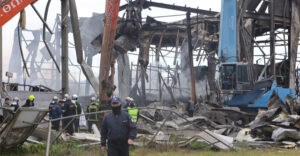
New details are emerging in the case of the deadly explosion at the Violanta factory, where five female workers lost their lives, following the testimony of a plumber from Trikala, who described how the external propane tank was connected to the building.
According to a report by ERTnews, the plumber from Trikala testified that he was called by the owner of Violynta to connect an external tank with a capacity of approximately 5,000 liters to the building. As he stated, a trench about one meter deep had already been dug from the tank to the foundations of the industrial facility, and he was asked to install a pipe measuring 8 to 10 meters in length for the connection.
He reportedly suggested lining the channel with concrete, both at the base and on the sides, so that the pipeline would not be in contact with the ground, as well as installing a metal access shaft to allow for easier inspection and control. However, according to his account, he was told that these measures would not be carried out and that the owner would assume responsibility.
“He told me: ‘I am the boss and you will do what I tell you. You install the pipe, and from here on I am responsible for whatever happens,’” the plumber is said to have testified.
He ultimately proceeded with installing the pipe. In a photograph revealed by ERTnews, a corroded pipe can be seen in the basement, placed directly on the ground, without sealing, and visibly damaged.
At the same time, the factory’s site plan showed the existence of underground tanks, while above-ground installations were also operating in the same area. The surveyor who did not include the underground space in the plan reportedly stated that he was aware of its existence but did not declare it, as he said it was not in use and was considered a “utility” but inactive space.
According to the same report, the gas shut-off valve was not connected to a leak detection system and was not installed on the main pipeline but on a branch line. Experts who examined the site estimate that even if leak detectors had existed inside the building, they would not have been able to function effectively, as the valve was disconnected and could not stop the gas supply.
“The leak appears to have occurred at a rate that was not detected by the safety valve of the propane tank, highlighting a serious safety gap,” experts note.
Ask me anything
Explore related questions